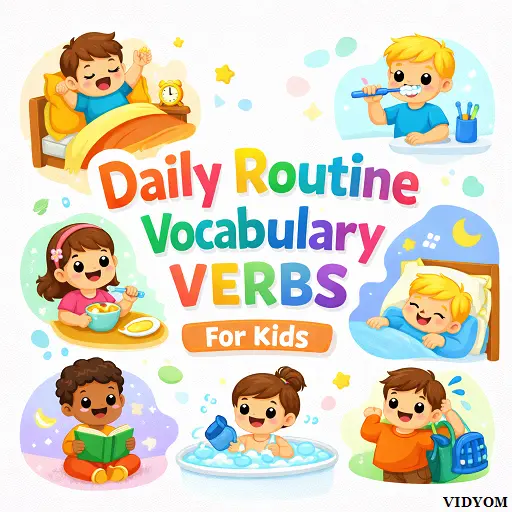
Daily routine vocabulary verbs: Lesson 5 (25 Words)
Welcome to daily routine vocabulary verbs. In this lesson, children will learn 25 easy action words we use every day, such as wake up, brush, eat, study, play, and sleep. First, tap Play Intro, listen carefully, and repeat each line. Next, practice these verbs during real routine time at home. This lesson is part of our learning platform for kids, so practice is simple and friendly. However, if your device does not support voice reading, the audio buttons will hide. In that case, parents can read the transcript and practice together.
Daily routine vocabulary verbs: Lesson 5 (25 Words)
Tap Play Audio to hear the word, meaning, and example. Then ask your child to repeat slowly. This lesson is part of our learning platform for kids, so practice is simple and fun.
1st Daily Routine Verbs (5 Words)
| Audio | Word | Meaning (Easy) | Example |
|---|---|---|---|
| Wake up | To stop sleeping and get up | I wake up early in the morning. | |
| Get up | To stand up from bed | I get up and make my bed. | |
| Brush | To clean teeth with a toothbrush | I brush my teeth every day. | |
| Wash face | To clean the face with water | I wash my face after waking up. | |
| Comb | To make hair neat with a comb | I comb my hair before school. |
2nd Daily Routine Verbs (5 Words)
| Audio | Word | Meaning (Easy) | Example |
|---|---|---|---|
| Take a bath | To wash the body with water | I take a bath in the morning. | |
| Get dressed | To put on clothes | I get dressed for school. | |
| Eat breakfast | To have morning food | I eat breakfast with my family. | |
| Pack | To put things in a bag | I pack my books carefully. | |
| Go to school | To travel to the school | I go to school with my friends. |
3rd Daily Routine Verbs (5 Words)
| Audio | Word | Meaning (Easy) | Example |
|---|---|---|---|
| Study | To learn by reading or practicing | I study in the evening. | |
| Write | To make letters or words on paper | I write my homework neatly. | |
| Read | To look at words and understand them | I read loudly with my teacher. | |
| Listen | To pay attention to sounds | I listen carefully to instructions. | |
| Answer | To reply to a question | I answer politely when asked. |
4th Daily Routine Verbs (5 Words)
| Audio | Word | Meaning (Easy) | Example |
|---|---|---|---|
| Come home | To return to home | I come home and wash my hands. | |
| Eat lunch | To have afternoon food | I eat lunch with my family. | |
| Do homework | To complete school work at home | I do homework before playing. | |
| Play | To do fun activities or games | I play outside for some time. | |
| Help | To do something to support others | I help my parents in the kitchen. |
5th Daily Routine Verbs (5 Words)
| Audio | Word | Meaning (Easy) | Example |
|---|---|---|---|
| Eat dinner | To have night meal | I eat dinner with my family. | |
| Take a walk | To walk for some time | I take a walk in the evening. | |
| Take rest | To relax after work | I take rest for a few minutes. | |
| Go to bed | To lie down to sleep | I go to bed after brushing. | |
| Sleep | To rest with eyes closed | I sleep early and wake up fresh. |
Practice tip: Learn 5 words today. Tomorrow, revise the old 5 words first, then learn 5 new words.

📲 Download VIDYOM App
Fun & interactive Kids Learning App! Install now and don’t forget to ⭐ rate us on Google Play.
Daily routine vocabulary verbs: Parents Guide
This lesson helps kids learn useful daily routine verbs like wake up, brush, eat, study, help, and sleep. First, practice only 5 words. Next, use real routine actions at home. Finally, repeat daily so your child remembers faster. This is a simple part of our learning platform for kids, so you can practice in a stress-free way.
✅ 10-Minute Daily Routine
- To begin with, pick 5 words from today’s set.
- Then, tap Play Audio and let your child listen calmly.
- Next, ask your child to repeat each word two times.
- After that, do the action together: “Brush”, “Pack”, “Read”.
- Finally, stop early while your child is still interested.
🏡 Practice with Real Routine Time
- For example, morning: wake up, wash face, brush.
- Next, school time: pack, go to school, study.
- After school: come home, do homework, play.
- Night time: eat dinner, go to bed, sleep.
- Most importantly, keep it fun—no pressure.
🎮 Quick Games for Daily Routine Verbs
- First, try Act It Out: say a verb and your child acts it.
- Then, play Routine Order: “wake up → brush → eat breakfast”.
- Next, do Fast Commands: read, write, listen, answer.
- Finally, do Yes/No: “Do we go to bed in the morning?”
🌟 Pronunciation and Revision Tips
- In addition, repeat slowly and clap once for each verb.
- Afterwards, revise yesterday’s 5 words before new words.
- However, if your child feels tired, take a short break and continue later.
- Finally, praise effort: “Good try!” “Great job!”