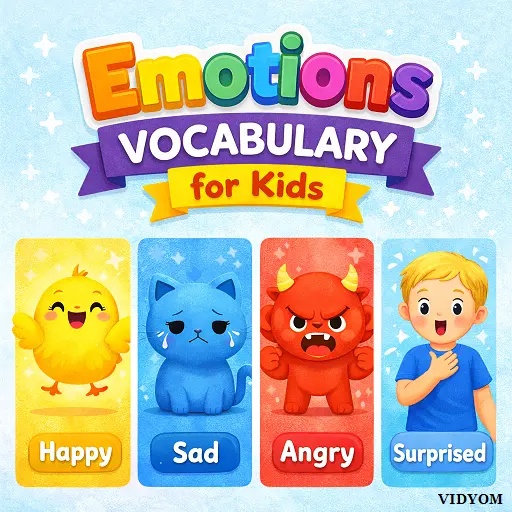
Emotions vocabulary for kids: Happy and sad (Lesson 1)
Welcome to emotions vocabulary for kids. In this lesson, children will learn easy feeling words for happy and sad, with simple meanings and short sentences. First, tap Play Intro, listen carefully, and repeat each line. However, if your device does not support voice reading, the audio buttons will hide. In that case, parents can read the transcript and practice together.
Emotions vocabulary for kids: Happy and sad (Lesson 1) (25 Words)
Tap Play Audio to hear the word, meaning, and example. Then help your child learn by repeating slowly.
1st Happy Words (5 Words)
| Audio | Word | Meaning (Easy) | Example |
|---|---|---|---|
| Happy | Feeling good and smiling | I feel happy when I play. | |
| Joyful | Very happy | I am joyful on my birthday. | |
| Smiling | Showing a happy face | She is smiling at the baby. | |
| Cheerful | Happy and full of energy | He is cheerful in the morning. | |
| Excited | Happy and ready for something | I am excited for the picnic. |
2nd Happy Words (5 Words)
| Audio | Word | Meaning (Easy) | Example |
|---|---|---|---|
| Proud | Happy about your own work | I feel proud of my drawing. | |
| Glad | Happy about something | I am glad to see you. | |
| Delighted | Very happy and pleased | Mom is delighted with my help. | |
| Content | Quietly happy and okay | I feel content after lunch. | |
| Thankful | Happy because you got help | I am thankful for your kindness. |
3rd Sad Words (5 Words)
| Audio | Word | Meaning (Easy) | Example |
|---|---|---|---|
| Sad | Feeling unhappy | I feel sad when I lose my toy. | |
| Upset | Sad or not okay | He is upset about the broken pencil. | |
| Crying | Tears come out because you feel sad | The baby is crying now. | |
| Lonely | Sad because you are alone | I feel lonely when no one plays with me. | |
| Disappointed | Sad because something did not happen | I am disappointed when the game ends. |
4th Sad Words (5 Words)
| Audio | Word | Meaning (Easy) | Example |
|---|---|---|---|
| Hurt | Feeling pain or feeling sad inside | My feelings get hurt when I am teased. | |
| Worried | Feeling sad or scared about something | I feel worried when mom is late. | |
| Bored | Feeling not interested | I feel bored when I have nothing to do. | |
| Guilty | Feeling bad because you did something wrong | I feel guilty when I lie. | |
| Shy | Feeling quiet and nervous with people | I feel shy in a new class. |
5th Mixed Feelings (5 Words)
| Audio | Word | Meaning (Easy) | Example |
|---|---|---|---|
| Calm | Feeling peaceful and quiet | I feel calm when I breathe slowly. | |
| Surprised | Feeling shock for a moment | I am surprised by the gift. | |
| Confused | Not sure what to do or understand | I feel confused with a hard question. | |
| Relaxed | Calm and comfortable | I feel relaxed after a warm bath. | |
| Hopeful | Feeling good about the future | I feel hopeful about tomorrow. |
Practice tip: Learn 5 words today. Tomorrow, revise the old 5 words first, then learn 5 new words.

📲 Download VIDYOM App
Fun & interactive Kids Learning App! Install now and don’t forget to ⭐ rate us on Google Play.
Emotions vocabulary for kids: Parents Guide
This lesson helps kids learn simple emotions words for happy and sad. First, listen and repeat. Next, connect the word to a real face and situation. Finally, practice short sentences daily.
✅ 10-Minute Daily Routine
- To begin with, choose 5 words from the lesson.
- Then, tap Play Audio and let your child listen calmly.
- Next, ask your child to repeat each word two times.
- After that, say: “Show a happy face”, “Show a sad face”.
- Finally, stop early while your child is still interested.
🙂😢 Learn with Real Moments
- For example, use daily moments: winning a game = happy.
- Next, losing a toy = sad.
- Meanwhile, ask: “How do you feel now?”
- In addition, use a mirror to show facial expressions.
- Most importantly, tell kids it is okay to feel sad sometimes.
🎮 Quick Games for Emotions Words
- First, play Face Match: say “happy” and make a smile.
- Then, play Story Time: “He got a gift, he is ___.”
- Next, do Point & Say: point to a picture and say the feeling.
- Finally, do Yes/No: “If ice cream falls, are you happy?”
🌟 Speaking and Revision Tips
- In addition, repeat slowly and clap once for each word.
- Afterwards, revise yesterday’s 5 words before new words.
- However, if your child is tired, take a short break and continue later.
- Finally, praise effort: “Good try!” “Great job!”