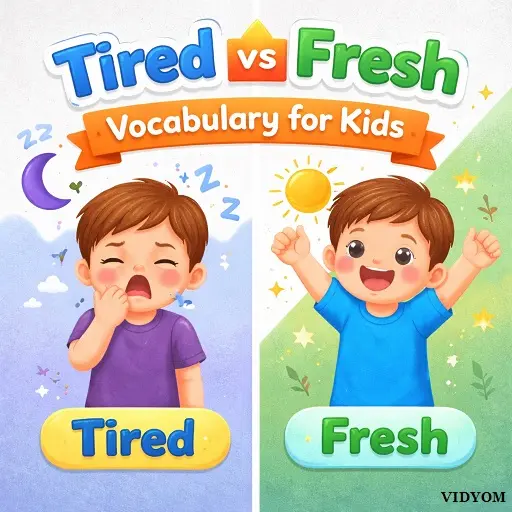
Tired fresh vocabulary for kids: Lesson 5 (25 Words)
Welcome to tired fresh vocabulary for kids. In this lesson, children will learn 25 easy feelings and energy words, such as tired, sleepy, fresh, active, and ready. First, tap Play Intro, listen carefully, and repeat slowly. This is helpful for parents who want a simple learning platform for kids at home. However, if your device does not support voice reading, the audio buttons will hide. In that case, parents can read the transcript and practice together.
Tired fresh vocabulary for kids: Lesson 5 (25 Words)
Tap Play Audio to hear the word, meaning, and example. Then ask your child to repeat slowly. This lesson works well as a simple learning platform for kids at home.
1st Tired and Fresh Words (5 Words)
| Audio | Word | Meaning (Easy) | Example |
|---|---|---|---|
| Tired | Needing rest after work or play | I feel tired after running. | |
| Sleepy | Feeling like you want to sleep | I am sleepy at night. | |
| Yawning | Opening your mouth when you feel sleepy | I am yawning in the evening. | |
| Weak | Not having much strength | I feel weak when I skip lunch. | |
| Lazy | Not wanting to do work | I feel lazy on a rainy day. |
2nd Tired and Fresh Words (5 Words)
| Audio | Word | Meaning (Easy) | Example |
|---|---|---|---|
| Exhausted | Very tired | I am exhausted after a long trip. | |
| Drowsy | Sleepy and not fully awake | I feel drowsy in the afternoon. | |
| Resting | Taking a break to relax | I am resting after school. | |
| Relaxed | Calm and comfortable | I feel relaxed after a bath. | |
| Sick | Not feeling well | I feel sick, so I rest at home. |
3rd Tired and Fresh Words (5 Words)
| Audio | Word | Meaning (Easy) | Example |
|---|---|---|---|
| Fresh | Feeling new, clean, and full of energy | I feel fresh after a good sleep. | |
| Active | Full of energy and ready to move | I am active in the morning. | |
| Energetic | Having lots of energy | I feel energetic after eating fruit. | |
| Ready | Prepared to do something | I am ready for school. | |
| Awake | Not sleeping; eyes open | I am awake early today. |
4th Tired and Fresh Words (5 Words)
| Audio | Word | Meaning (Easy) | Example |
|---|---|---|---|
| Lively | Full of life and energy | The class feels lively today. | |
| Cheerful | Feeling happy and bright | I feel cheerful when I play. | |
| Refreshed | Feeling fresh again after rest | I feel refreshed after a nap. | |
| Comfortable | Feeling okay and relaxed | I feel comfortable on my bed. | |
| Bright | Looking happy and full of energy | My face looks bright after I rest. |
5th Tired and Fresh Words (5 Words)
| Audio | Word | Meaning (Easy) | Example |
|---|---|---|---|
| Rested | Not tired because you rested well | I feel rested after sleeping early. | |
| Calm | Quiet and peaceful inside | I feel calm when I breathe slowly. | |
| Motivated | Wanting to do something | I feel motivated to finish my work. | |
| Healthy | Feeling well in the body | I feel healthy when I eat good food. | |
| Confident | Feeling sure you can do it | I feel confident before my test. |
Practice tip: Learn 5 words today. Tomorrow, revise the old 5 words first, then learn 5 new words.

📲 Download VIDYOM App
Fun & interactive Kids Learning App! Install now and don’t forget to ⭐ rate us on Google Play.
Tired fresh vocabulary for kids: Parents Guide
This lesson helps kids learn useful tired and fresh feeling words like tired, sleepy, relaxed, fresh, active, and ready. First, practice only 5 words. Next, connect the words to real daily moments. Finally, repeat daily for better speaking. This style is perfect for a simple learning platform for kids at home.
✅ 10-Minute Daily Routine
- To begin with, pick 5 words from today’s set.
- Then, tap Play Audio and let your child listen calmly.
- Next, ask your child to repeat each word two times.
- After that, make a simple line: “I feel tired.” “I feel fresh.”
- Finally, stop early while your child is still interested.
😴 Use Real Daily Moments
- After play: say tired, exhausted, thirsty (if needed) and take rest.
- Before bed: practice sleepy, drowsy, yawning.
- After bath: say relaxed, comfortable.
- After good sleep: say fresh, rested, energetic.
- Most importantly, keep the practice short and fun.
🎮 Quick Games for Feelings Words
- First, try Act It: “Show me tired!” “Show me fresh!”
- Then, play Face Match: make a face and guess the word.
- Next, do Yes/No: “Are you sleepy in the morning?”
- Finally, do Two Choices: “Are you tired or energetic?”
🌟 Pronunciation and Revision Tips
- In addition, say the word slowly and clap once: “ti-red”.
- Afterwards, revise yesterday’s 5 words before new words.
- However, if your child looks tired, take a short break and continue later.
- Finally, praise effort: “Good try!” “Great job!”