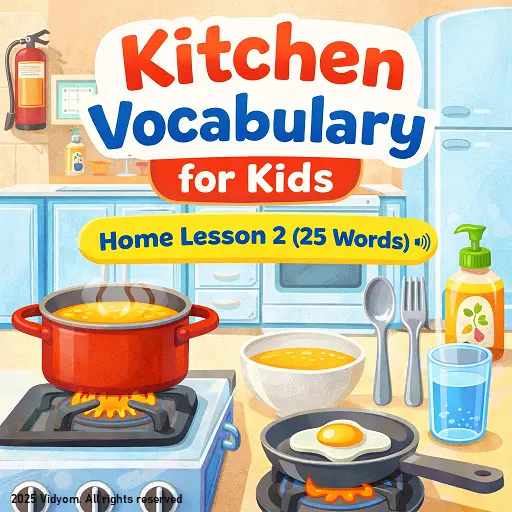
Kitchen Vocabulary for Kids Home Lesson 2 (25 Words) With Audio
Welcome to kitchen vocabulary for kids. In this lesson, children will learn 25 easy kitchen words we use every day at home, such as plate, spoon, cup, stove, water, and food. Tap Play Intro, listen carefully, and repeat each word. If your device does not support voice reading, the audio buttons will hide and parents can read the transcript below and practice step by step.
Kitchen Vocabulary for Kids – Home Lesson 2 (25 Words) With Audio
Tap Play Audio to hear the word, meaning, and example. Ask your child to repeat after listening.
1st Day Kitchen Vocabulary for Kids (5 Words)
| Audio | Word | Meaning (Easy) | Example |
|---|---|---|---|
| Kitchen | A room where we cook food | My mother cooks in the kitchen. | |
| Cook | To make food using heat | We cook rice for lunch. | |
| Stove | A tool used for cooking | The pot is on the stove. | |
| Gas | Fuel used for cooking | We use gas to cook food. | |
| Fire | Hot flames that cook food | Keep your hands away from fire. |
2nd Day Kitchen Vocabulary for Kids (5 Words)
| Audio | Word | Meaning (Easy) | Example |
|---|---|---|---|
| Pot | A deep vessel for cooking | Soup is in the pot. | |
| Pan | A flat vessel for cooking | Eggs cook in a pan. | |
| Plate | A dish to eat food on | I eat on a plate. | |
| Bowl | A round dish for food | Cereal is in the bowl. | |
| Cup | A small container for drinking | I drink milk in a cup. |
3rd Day Kitchen Vocabulary for Kids (5 Words)
| Audio | Word | Meaning (Easy) | Example |
|---|---|---|---|
| Spoon | A tool to eat or stir food | I eat soup with a spoon. | |
| Fork | A tool with prongs for eating | I eat noodles with a fork. | |
| Knife | A tool used for cutting food | Use a knife to cut fruit. | |
| Cut | To divide with a knife | I cut the apple into pieces. | |
| Stir | To mix with a spoon | I stir the tea with a spoon. |
4th Day Kitchen Vocabulary for Kids (5 Words)
| Audio | Word | Meaning (Easy) | Example |
|---|---|---|---|
| Wash | To clean with water | I wash the dishes. | |
| Clean | Not dirty; tidy | Keep the kitchen clean. | |
| Dish | A plate or bowl used for food | Put the dish on the table. | |
| Soap | A thing used for cleaning | Use soap to wash hands. | |
| Water | A liquid we drink and use | Pour water into the glass. |
5th Day Kitchen Vocabulary for Kids (5 Words)
| Audio | Word | Meaning (Easy) | Example |
|---|---|---|---|
| Food | Things we eat | Food gives us energy. | |
| Hot | Very warm; can burn | The soup is hot. | |
| Cold | Not warm; cool | The water is cold. | |
| Taste | The flavor of food | The curry has a good taste. | |
| Eat | To take food into the mouth | I eat my lunch. |
Practice tip: Learn 5 words today, and revise the same 5 words tomorrow.

📲 Download VIDYOM App
Fun & interactive Kids Learning App! Install now and don’t forget to ⭐ rate us on Google Play.
Parents Guide to Teach Kitchen Words at Home
You don’t need to be a teacher. Instead, you can use your own kitchen to teach these words in a fun way. First, start small. Next, repeat daily. Then, use the words during real cooking and eating time. As a result, children learn faster because they see and touch the items. Most importantly, keep practice happy and short.
✅ Easy 10-Minute Routine
- To begin with, choose only 5 words today (small steps work best).
- Next, tap Play Audio and let your child listen calmly.
- Then, ask your child to repeat each word two times slowly.
- After that, say one small sentence together, for example: “This is a spoon.”
- Finally, stop early and celebrate effort with a smile.
🍲 Teach with Real Kitchen Items
- First, pick real items like pot, pan, plate, bowl, cup.
- Next, point and ask: “What is this?” and let your child answer.
- Then, let your child touch the item and say the word clearly.
- In addition, connect action words: “Wash the plate”, “Stir the tea”.
- Most importantly, keep it safe—no sharp tools in kids’ hands.
🎮 Quick 1-Minute Games
- First, try Find It: “Bring the spoon!”
- Next, play Point & Say: you point, your child says the word.
- Then, do Action Time: “Show me ‘stir’!” (act the action).
- Finally, ask Yes/No: “Is this a bowl?”
🌟 Revision and Motivation Tips
- First, praise effort: “Good try!” “Great job!” even if pronunciation is not perfect.
- Next, revise yesterday’s 5 words before learning new words.
- Afterwards, repeat the words in normal talk during the day.
- However, if your child feels bored, take a short break and continue later.
- Finally, repeat the same words for 3 days to make memory strong.