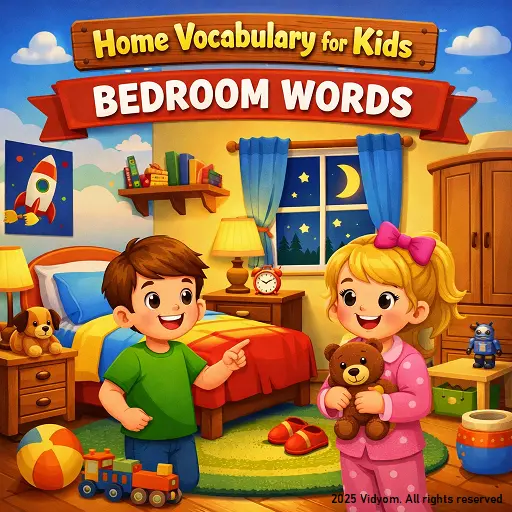
Bedroom Vocabulary for Kids Bedroom Words (25 Words) With Audio
Welcome to bedroom vocabulary for kids. In this lesson, children will learn 25 easy bedroom words such as bed, pillow, blanket, cupboard, lamp, and more. Tap Play Intro, listen carefully, and repeat each word slowly. If your device does not support voice reading, the audio buttons will hide. In that case, parents can read the transcript and teach kids easily.
Bedroom Vocabulary for Kids – Home Vocabulary Lesson 3 (25 Words) With Audio
Tap Play Audio to hear the word, meaning, and example. Then ask your child to repeat slowly.
1st Bedroom Vocabulary for Kids (5 Words)
| Audio | Word | Meaning (Easy) | Example |
|---|---|---|---|
| Bed | A place to sleep | I sleep on my bed. | |
| Pillow | A soft cushion for the head | I put my head on a pillow. | |
| Bedsheet | A cloth that covers the bed | The bedsheet is clean. | |
| Blanket | A warm cover for sleeping | I use a blanket at night. | |
| Mattress | The soft part of a bed to lie on | The mattress feels soft. |
2nd Bedroom Vocabulary for Kids (5 Words)
| Audio | Word | Meaning (Easy) | Example |
|---|---|---|---|
| Quilt | A thick blanket for warmth | I sleep under a quilt. | |
| Wardrobe | A cupboard for clothes | My clothes are in the wardrobe. | |
| Cupboard | A cabinet to keep things | Keep your toys in the cupboard. | |
| Drawer | A sliding box in a table or cupboard | My socks are in the drawer. | |
| Hanger | A tool to hang clothes | Hang your shirt on a hanger. |
3rd Bedroom Vocabulary for Kids (5 Words)
| Audio | Word | Meaning (Easy) | Example |
|---|---|---|---|
| Mirror | Glass that shows your face | I see my face in the mirror. | |
| Lamp | A light for the room | The lamp is on at night. | |
| Fan | A machine that gives air | The fan keeps us cool. | |
| Window | An opening to see outside | I open the window in the morning. | |
| Curtain | Cloth that covers a window | The curtain is blue. |
4th Bedroom Vocabulary for Kids (5 Words)
| Audio | Word | Meaning (Easy) | Example |
|---|---|---|---|
| Door | An entry to a room | Please close the door. | |
| Shelf | A flat place to keep things | Keep books on the shelf. | |
| Toy box | A box to keep toys | Put toys in the toy box. | |
| Clock | A thing that shows time | The clock shows the time. | |
| Dustbin | A bin for waste | Throw paper in the dustbin. |
5th Bedroom Vocabulary for Kids (5 Words)
| Audio | Word | Meaning (Easy) | Example |
|---|---|---|---|
| Teddy | A soft toy bear | I hug my teddy. | |
| Book | Something we read | I read a book before sleep. | |
| Sleep | To rest with closed eyes | I sleep at night. | |
| Clean | Not dirty | My bedroom is clean. | |
| Messy | Not neat; not clean | My bed looks messy. |
Practice tip: First do one set today, then revise again tomorrow for better memory.

📲 Download VIDYOM App
Fun & interactive Kids Learning App! Install now and don’t forget to ⭐ rate us on Google Play.
Parents Guide – to Teach Bedroom Words at Home
You don’t need to be a teacher. First, keep practice short and friendly. Next, use real bedroom things like bed, pillow, and lamp while teaching. Most importantly, repeat the same words daily, so your child learns naturally and speaks with confidence.
✅ Easy Daily Routine (8–10 Minutes)
- To begin with, choose only 5 words today (small steps work best).
- Then, tap Play Audio and let your child listen calmly.
- Next, ask them to repeat each word two times slowly.
- After that, say one short sentence together, for example: “This is my bed.”
- Finally, stop early before your child gets tired.
🛏️ Learn with Real Bedroom Items
- For example, point to real things: bed, pillow, blanket, curtain, wardrobe.
- Next, ask: “What is this?” and let your child answer.
- Then, ask: “What do we do with it?” for example: “We sleep on the bed.”
- In addition, touch and show: “Open the drawer”, “Close the door”.
- Most importantly, keep it fun—no pressure, no scolding.
🎮 Quick Bedroom Games (1–2 Minutes)
- First, try Find It: “Find the pillow!” and your child points to it.
- Then, play Touch & Say: touch the item and say the word together.
- Next, use Clean Up: “Put the book on the shelf.”
- Finally, ask Yes/No: “Is this a lamp?”
🌟 Motivation and Revision Tips
- In addition, praise effort: “Good try!” “Great job!” even if pronunciation is not perfect.
- Afterwards, repeat the same words at night: “Pillow”, “Blanket”, “Sleep”.
- However, if your child feels bored, take a short break and continue later.
- Finally, revise yesterday’s 5 words first, and only then start new words.