Bathroom vocabulary for kids Home Vocabulary Lesson 4 (25 Words) With Audio
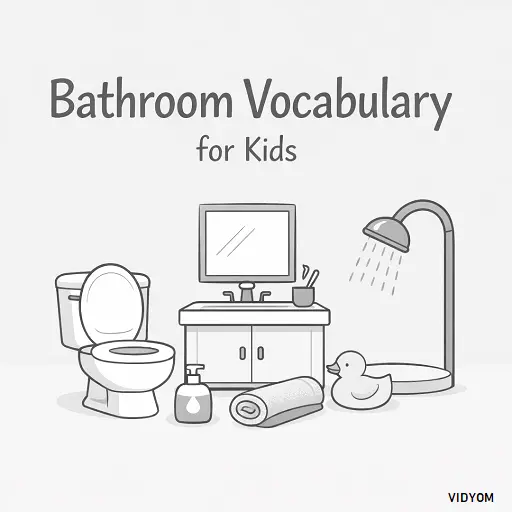
Welcome to bathroom vocabulary for kids. First, your child will learn 25 simple home words we use every day, such as tap, soap, towel, toothbrush, and mirror. Next, tap Play Intro, listen carefully, and repeat. This lesson is part of our vocabulary for kids series and is perfect for Pre-KG, LKG, and UKG. Also, parents can use these as bathroom words for kids for quick daily practice. However, if your device does not support voice reading, the audio buttons will hide. In that case, please read the transcript below.
Bathroom vocabulary for kids – Home Vocabulary Lesson 4 (25 Words) With Audio
Tap Play Audio to hear the word, meaning, and example. Then ask your child to repeat slowly for clear pronunciation.
1st Bathroom Vocabulary (5 Words)
| Audio | Word | Meaning (Easy) | Example |
|---|---|---|---|
| Bathroom | A room for washing and using the toilet | The bathroom is inside our home. | |
| Washroom | Another name for bathroom | Please go to the washroom. | |
| Toilet | A place to pass urine and stool | I flush the toilet after use. | |
| Sink | A bowl with a tap for washing hands | Wash your hands in the sink. | |
| Tap | A handle to turn water on or off | Turn off the tap after washing. |
2nd Bathroom Vocabulary (5 Words)
| Audio | Word | Meaning (Easy) | Example |
|---|---|---|---|
| Soap | Something that cleans hands and body | Use soap to clean your hands. | |
| Shampoo | Liquid to wash hair | I use shampoo to wash my hair. | |
| Toothbrush | A brush for cleaning teeth | I use a toothbrush every morning. | |
| Toothpaste | Cream used with a toothbrush | Put toothpaste on the brush. | |
| Mouthwash | Liquid to rinse the mouth | I rinse with mouthwash after brushing. |
3rd Bathroom Vocabulary (5 Words)
| Audio | Word | Meaning (Easy) | Example |
|---|---|---|---|
| Towel | Cloth used to dry the body | I dry with a towel after bath. | |
| Bucket | A container to hold water | Fill the bucket with water. | |
| Mug | A small container to pour water | I use a mug to pour water. | |
| Bath | Washing the body with water | I take a bath every day. | |
| Shower | Bath with water coming from above | I take a shower in the bathroom. |
4th Bathroom Vocabulary (5 Words)
| Audio | Word | Meaning (Easy) | Example |
|---|---|---|---|
| Mirror | Glass that shows our face | I look in the mirror. | |
| Comb | Tool to make hair neat | I use a comb after bath. | |
| Razor | Tool to shave hair (for adults) | My father uses a razor carefully. | |
| Toilet paper | Paper used to clean after toilet | Take some toilet paper, please. | |
| Flush | To send water to clean the toilet | Flush the toilet after use. |
5th Bathroom Vocabulary (5 Words)
| Audio | Word | Meaning (Easy) | Example |
|---|---|---|---|
| Clean | Not dirty | My hands are clean now. | |
| Dirty | Not clean | My hands are dirty after playing. | |
| Wipe | To clean by rubbing with cloth or paper | Wipe the sink with a cloth. | |
| Wet | Not dry; full of water | My hands are wet after washing. | |
| Dry | Not wet | Dry your hands with a towel. |
Practice tip: First, do one set today. Then revise the previous sets tomorrow. This small daily routine helps kids remember faster.
Parents Guide to Teach Bathroom Words
You don’t need to be a teacher. Instead, use this simple routine to teach bathroom vocabulary for kids in a fun way. First, practice only 5 words. Next, use real bathroom items. Finally, revise daily, so your child remembers faster. This lesson also supports your vocabulary for kids practice at home.
✅ Easy Plan (10 Minutes)
- To begin with, choose Set 1 today (only 5 words).
- Then, tap Play Audio and let your child listen calmly.
- Next, ask your child to repeat each word two times slowly.
- After that, read one small example sentence together.
- Finally, stop early and praise your child.
🧼 Learn with Real Bathroom Items
- For example, show real items: soap, towel, toothbrush, tap, mirror.
- Next, ask: “What is this?” and “What do we do with it?”
- Meanwhile, let your child touch/point and say the word clearly.
- In addition, use these as bathroom words for kids during daily routine.
- Most importantly, keep it fun—no pressure, no scolding.
🎮 Quick Games (1 Minute)
- First, play Find it: “Show me the towel.”
- Then, try Do the action: “Wash hands” / “Brush teeth”.
- Next, play Yes or No: “Is this a sink?”
- Finally, play Fast repeat: say 3 words quickly and repeat together.
🌟 Pronunciation + Revision Tips
- In addition, speak slowly and clearly, and repeat the same word again later.
- Afterwards, revise yesterday’s 5 words first, and only then start new words.
- However, if your child feels bored, take a short break and continue later.
- Also, you can say “bathroom” and “washroom” as washroom vocabulary for kids practice.

📲 Download VIDYOM App
Fun & interactive Kids Learning App! Install now and don’t forget to ⭐ rate us on Google Play.