❤️ Human Heart Facts for Kids – Amazing & Fun
Welcome to our heart fact for kids page—tap play, enjoy pictures, and learn how this fist-sized muscle beats, pumps blood, and keeps you energised! Your heart works non-stop, sending oxygen and nutrients to every part of your body and carrying away waste. You’ll discover what the “lub-dub” sound means, how your pulse changes when you run or rest, and why healthy habits like water, sleep, and daily play help your heart stay strong for life.
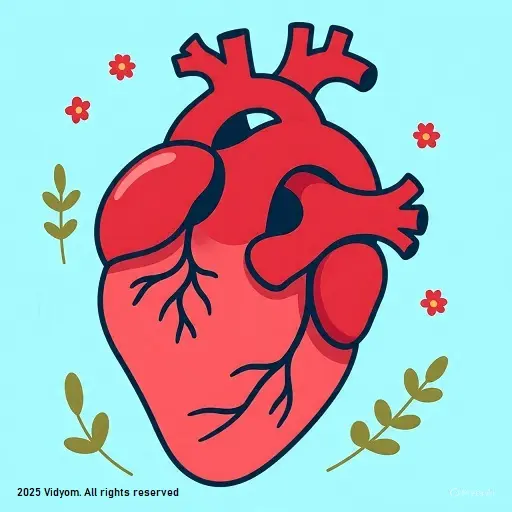
- Your heart beats about 100,000 times a day to move blood.
- It’s a powerful muscle pump that sends oxygen everywhere.
- Your heart is roughly the size of your fist.
- It has four chambers: two atria and two ventricles.
- Daily play and exercise help keep the heart strong and healthy.
- Valves act like tiny doors so blood flows the right way—the “lub-dub” sound is valves closing.
- Blood travels in tubes called arteries, veins, and capillaries all over your body.
- You can feel your pulse at your wrist or neck to count heartbeats per minute.
- Your heart beats faster when you run and slower when you rest or sleep.
- The right side sends blood to the lungs to pick up oxygen; the left side sends oxygen-rich blood to the whole body.
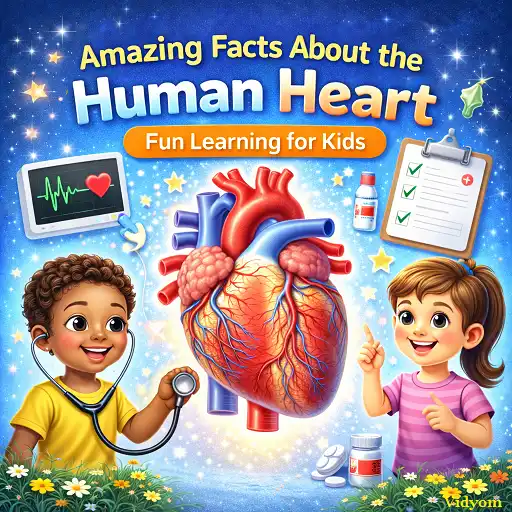
🧠 heart fact for kids – Q&A Practice (10 Questions)
Parents: ask the question first. Let the child answer. Then tap to open and check the hidden answer. This improves listening, speaking, and memory.
1
What is the heart’s main job?Tap to reveal answerThe heart’s main job is to pump blood around the body.2
About how big is your heart?Tap to reveal answerIt’s about the size of your fist.3
How many chambers does the heart have?Tap to reveal answerThe heart has four chambers.4
What do we call the “lub-dub” sound?Tap to reveal answerIt’s the sound of heart valves closing as blood moves through.5
Where can you feel your pulse?Tap to reveal answerYou can feel your pulse at your wrist or neck.6
When does your heart beat faster?Tap to reveal answerIt beats faster when you run, play, or exercise.7
When does your heart beat slower?Tap to reveal answerIt beats slower when you rest or sleep.8
Where does the right side of the heart send blood?Tap to reveal answerTo the lungs to pick up oxygen.9
Where does the left side of the heart send oxygen-rich blood?Tap to reveal answerTo the whole body.10
Name one way to keep your heart healthy.Tap to reveal answerPlay, exercise, eat healthy foods, and sleep well to keep your heart strong.
heart fact for kids: Quick Recap 30 seconds
On our kids education website, this listen-and-read page stays playful: see the picture, tap play, repeat—on a friendly learning platform for kids. Today’s heart fact for kids covers beats, chambers, and healthy habits.
👩🏫 For Parents & Teachers — 6 easy steps (5–8 min)
Try this routine
- Play the audio while the child places a hand over their chest to feel beats.
- Ask: “About how many times does a heart beat daily?” (≈100,000).
- Read one line: “The heart is a muscle pump with four chambers.”
- Child repeats (speaking practice).
- Point-and-name: atrium, ventricle, oxygen, pulse.
- Tomorrow, do 30 seconds of jogging; compare resting vs. active pulse.
Builds listening → speaking → vocabulary → recall—plus a tiny science activity.
heart fact for kids: Read-Aloud Support parents’ helper
- Say: “My heart is a strong muscle that pumps blood.”
- Say: “It has four rooms called chambers.”
- Say: “Moving and playing make my heart healthy.”
✨ You Might Also Like


📲 Download VIDYOM App
Fun & interactive Kids Learning App! Install now and don’t forget to ⭐ rate us on Google Play.
heart fact for kids: Quick FAQ for families
These short answers help kids understand how the human heart works.
What does the heart do?
It pushes blood with oxygen and nutrients to every part of the body.
How big is a child’s heart?
Roughly the size of their fist—hearts grow as kids grow.
Why does my heart beat faster when I run?
Your muscles need more oxygen, so the heart pumps faster to deliver it.
How can I keep my heart healthy?
Play daily, eat fruits/veggies, sleep well, and drink water.
Is the heart on the left side?
Mostly centered but tilted left, so we often feel beats on the left.
Learn More – For Parents & Teachers
- KidsHealth: The Heart & Circulatory System
- British Heart Foundation: How Your Heart Works
- National Geographic Kids: Heart
External links open in a new tab and are intended for adult guidance and deeper reading.