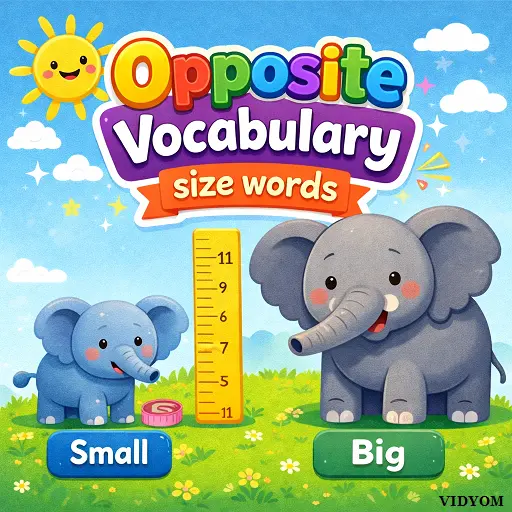
Opposite vocabulary size words: Lesson 1 (25 Words)
Welcome to opposite vocabulary size words. In this lesson, children will learn easy size opposites such as big and small, tall and short, and heavy and light. First, tap Play Intro, listen carefully, and repeat each line. However, if your device does not support voice reading, the audio buttons will hide. In that case, parents can read the transcript and practice together on this learning platform for kids.
Opposite vocabulary size words: Lesson 1 (25 Words)
Tap Play Audio to hear the word, meaning, and example. Then ask your child to repeat slowly. This lesson is part of our learning platform for kids.
1st Size Opposites (5 Words)
| Audio | Word | Meaning (Easy) | Example |
|---|---|---|---|
| Big | Large in size | The elephant is big. | |
| Small | Not big; little | The ant is small. | |
| Tall | High in height | The giraffe is tall. | |
| Short | Not tall; low in height | The boy is short. | |
| Long | Having a great length | The rope is long. |
2nd Size Opposites (5 Words)
| Audio | Word | Meaning (Easy) | Example |
|---|---|---|---|
| Thin | Not thick; little in width | This paper is thin. | |
| Thick | Not thin; wide in width | The book is thick. | |
| Wide | Large from side to side | The road is wide. | |
| Narrow | Not wide; small side to side | This lane is narrow. | |
| High | Far above the ground | The kite is high in the sky. |
3rd Size Opposites (5 Words)
| Audio | Word | Meaning (Easy) | Example |
|---|---|---|---|
| Low | Not high; near the ground | The chair is low. | |
| Heavy | Not light; has a lot of weight | This bag is heavy. | |
| Light | Not heavy; easy to lift | The balloon is light. | |
| Deep | Going far down | The well is deep. | |
| Shallow | Not deep; not far down | This water is shallow. |
4th Size Opposites (5 Words)
| Audio | Word | Meaning (Easy) | Example |
|---|---|---|---|
| Near | Not far; close | My home is near the school. | |
| Far | Not near; at a long distance | The village is far from the city. | |
| Full | Having no more space inside | The glass is full. | |
| Empty | Having nothing inside | The box is empty. | |
| Strong | Having a lot of power | A lion is strong. |
5th Size Opposites (5 Words)
| Audio | Word | Meaning (Easy) | Example |
|---|---|---|---|
| Weak | Not strong; less power | After illness, I feel weak. | |
| Hard | Not soft; difficult to press | This stone is hard. | |
| Soft | Not hard; easy to press | This pillow is soft. | |
| Smooth | Not rough; even surface | The table is smooth. | |
| Rough | Not smooth; uneven surface | This wall is rough. |
Practice tip: Learn 5 words today. Tomorrow, revise the old 5 words first, then learn 5 new words.

📲 Download VIDYOM App
Fun & interactive Kids Learning App! Install now and don’t forget to ⭐ rate us on Google Play.
Opposite vocabulary size words: Parents Guide
This lesson helps kids learn size opposite words like big and small, tall and short, and heavy and light. First, practice only 5 words. Next, show the difference using real objects at home. Finally, repeat daily so your child remembers faster on this learning platform for kids.
✅ 10-Minute Daily Routine
- To begin with, pick 5 words from today’s set.
- Then, tap Play Audio and let your child listen calmly.
- Next, ask your child to repeat each word two times.
- After that, say the opposite pair together: “big–small”, “tall–short”.
- Finally, stop early while your child is still interested.
🏠 Learn with Real Objects
- For example, show two things: big ball and small ball.
- Next, compare height: a tall bottle and a short cup.
- Then, compare weight safely: a heavy book and a light paper.
- After that, ask: “Which one is big?” and “Which one is small?”
- Most importantly, keep it fun—no pressure.
🎮 Quick Games for Size Opposites
- First, try Point & Say: point to objects and say “big/small”.
- Then, play Bring Me: “Bring a small spoon” / “Bring a big plate”.
- Next, do Draw Two: draw a big circle and a small circle.
- Finally, do Yes/No: “Is an ant big?” “Is an elephant small?”
🌟 Pronunciation and Revision Tips
- In addition, say pairs slowly with clear pauses: “tall… short”.
- Afterwards, revise yesterday’s 5 words before new words.
- However, if your child feels tired, take a short break and continue later.
- Finally, praise effort: “Good try!” “Great job!”