Opposite vocabulary time words: Lesson 3 (25 Words)
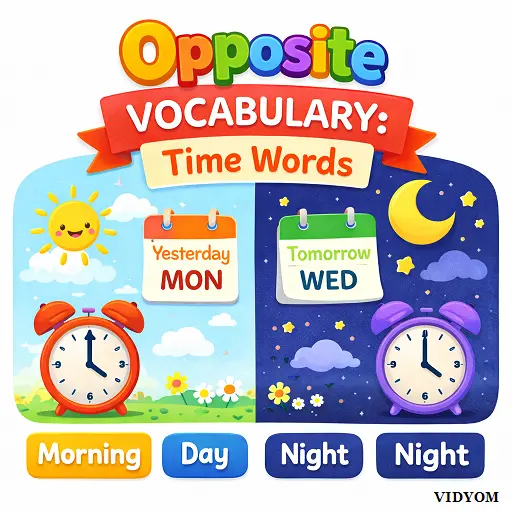
Welcome to opposite vocabulary time words. In this lesson, children will learn easy time opposite words such as day and night, early and late, before and after, and now and later. First, tap Play Intro, listen carefully, and repeat each line slowly. Next, practice the words daily and use them in small sentences. This lesson is also a helpful part of our learning platform for kids. However, if your device does not support voice reading, the audio buttons will hide. In that case, parents can read the transcript and practice together.
Opposite vocabulary time words: Lesson 3 (25 Words)
Tap Play Audio to hear the opposite pair, meaning, and example. Then ask your child to repeat slowly. This is part of our learning platform for kids.
1st Time Opposites (5 Pairs)
| Audio | Opposite Pair | Meaning (Easy) | Example |
|---|---|---|---|
| Day / Night | Day is bright time; night is dark time | We play in the day and sleep at night. | |
| Morning / Evening | Morning is early in the day; evening is later | I wake up in the morning and come home in the evening. | |
| Early / Late | Early means before time; late means after time | I go early to school, not late. | |
| Before / After | Before means earlier; after means later | Wash hands before eating and after playing. | |
| Now / Later | Now means at this time; later means after some time | Do homework now and play later. |
2nd Time Opposites (5 Pairs)
| Audio | Opposite Pair | Meaning (Easy) | Example |
|---|---|---|---|
| Today / Tomorrow | Today is this day; tomorrow is the next day | Today we study, tomorrow we revise. | |
| Yesterday / Today | Yesterday is the day before; today is this day | Yesterday it rained, today it is sunny. | |
| First / Last | First means at the beginning; last means at the end | I am first in line and my friend is last. | |
| Start / Finish | Start means begin; finish means end | We start the game and finish it in time. | |
| Begin / End | Begin means start; end means stop | The class begins at 10 and ends at 11. |
3rd Time Opposites (5 Pairs)
| Audio | Opposite Pair | Meaning (Easy) | Example |
|---|---|---|---|
| Always / Never | Always means every time; never means not at any time | I always say please, I never shout. | |
| Often / Seldom | Often means many times; seldom means not many times | We often visit grandma, but we seldom travel far. | |
| Sometimes / Always | Sometimes means not every time; always means every time | I sometimes play outside, but I always brush my teeth. | |
| Soon / Late | Soon means after a short time; late means after a long time | I will come soon, not late. | |
| Quickly / Slowly | Quickly means fast; slowly means not fast | Walk quickly to school, but eat slowly. |
4th Time Opposites (5 Pairs)
| Audio | Opposite Pair | Meaning (Easy) | Example |
|---|---|---|---|
| Past / Present | Past is before now; present is now | We talk about the past and the present. | |
| Present / Future | Present is now; future is later time | Today is present, and tomorrow is future. | |
| Short time / Long time | Short time is little time; long time is more time | A short time to wait, but a long time to travel. | |
| Few minutes / Many minutes | Few minutes is small time; many minutes is more time | It takes few minutes to wash hands, but many minutes to cook. | |
| Same time / Different time | Same time means together; different time means not together | We eat at the same time, but we sleep at different times. |
5th Time Opposites (5 Pairs)
| Audio | Opposite Pair | Meaning (Easy) | Example |
|---|---|---|---|
| On time / Late | On time means not late; late means after time | Come on time to class, not late. | |
| Long ago / Now | Long ago means in the past; now means present | Long ago we used candles, now we use lights. | |
| Next / Previous | Next means coming after; previous means coming before | This is the previous page, and this is the next page. | |
| New / Old | New means not used; old means used before | I have a new bag and an old bag. | |
| Young / Old | Young means not very old; old means aged | My brother is young, but my grandpa is old. |
Practice tip: Learn 5 pairs today. Tomorrow, revise the old 5 pairs first, then learn 5 new pairs.

📲 Download VIDYOM App
Fun & interactive Kids Learning App! Install now and don’t forget to ⭐ rate us on Google Play.
Opposite vocabulary time words: Parents Guide
This lesson helps kids learn useful time opposite words like day and night, early and late, before and after, and now and later. First, practice only 5 pairs. Next, use real daily routines. Finally, repeat daily so your child remembers faster. This lesson also supports our learning platform for kids.
✅ 10-Minute Daily Routine
- To begin with, pick 5 opposite pairs from today’s set.
- Then, tap Play Audio and let your child listen calmly.
- Next, ask your child to repeat each pair two times.
- After that, ask: “What is the opposite of day?” → “Night”.
- Finally, stop early while your child is still interested.
⏰ Learn with Real Daily Time
- For example, use your routine: morning/evening, now/later.
- Next, say short lines: “We play in the day. We sleep at night.”
- Meanwhile, point to a clock and say: “Early” and “Late”.
- In addition, use meal time: “Before lunch” and “After lunch”.
- Most importantly, keep it fun—no pressure.
🎮 Quick Games for Time Opposites
- First, play Opposite Flash: You say “before”, child says “after”.
- Then, try Now or Later: “Homework now or later?”
- Next, do Day Night Action: day = clap, night = hands on head.
- Finally, do True or False: “We sleep in the day.” (false)
🌟 Speaking and Revision Tips
- In addition, say each pair slowly and clearly.
- Afterwards, revise yesterday’s 5 pairs before new pairs.
- However, if your child feels tired, take a short break and continue later.
- Finally, praise effort: “Good try!” “Great job!”