Opposite vocabulary feelings words: Lesson 4 (25 Words)
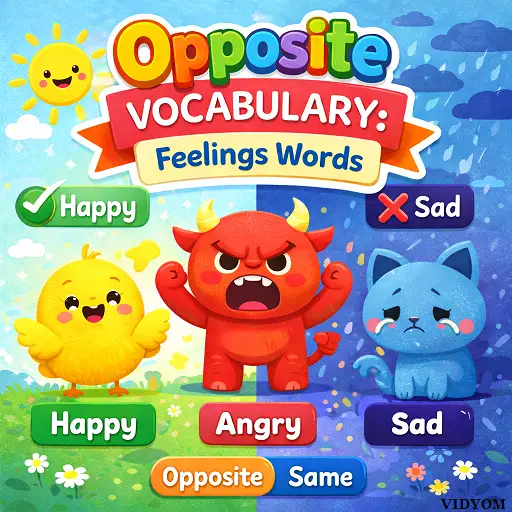
Welcome to opposite vocabulary feelings words. In this lesson, children will learn easy feeling opposites such as happy and sad, calm and angry, brave and scared, and more. First, tap Play Intro, listen carefully, and repeat each line. This is a simple practice for parents and kids using a friendly learning platform for kids. However, if your device does not support voice reading, the audio buttons will hide. In that case, parents can read the transcript and practice together.
Opposite vocabulary feelings words: Lesson 4 (25 Words)
Tap Play Audio to hear the word, meaning, and example. Then ask your child to repeat slowly. This simple practice works well on a learning platform for kids.
1st Feeling Opposites (5 Words)
| Audio | Word | Meaning (Easy) | Example |
|---|---|---|---|
| Happy | Feeling good and joyful | I feel happy when I play. | |
| Sad | Feeling unhappy | I feel sad when my toy breaks. | |
| Calm | Feeling quiet and relaxed | I stay calm during story time. | |
| Angry | Feeling mad or upset | I feel angry when someone shouts. | |
| Brave | Not afraid; very bold | I am brave at the doctor. |
2nd Feeling Opposites (5 Words)
| Audio | Word | Meaning (Easy) | Example |
|---|---|---|---|
| Scared | Feeling afraid | I feel scared in a dark room. | |
| Confident | Feeling sure you can do it | I feel confident to read aloud. | |
| Excited | Feeling very happy and eager | I feel excited for my birthday. | |
| Bored | Feeling not interested | I feel bored when I wait too long. | |
| Proud | Feeling happy about doing well | I feel proud when I finish my work. |
3rd Feeling Opposites (5 Words)
| Audio | Word | Meaning (Easy) | Example |
|---|---|---|---|
| Shy | Feeling nervous to talk | I feel shy in a new class. | |
| Friendly | Kind and nice to others | I am friendly with my classmates. | |
| Lazy | Not wanting to work | I feel lazy on a rainy day. | |
| Active | Full of energy | I am active when I play outside. | |
| Tired | Needing rest | I feel tired after running. |
4th Feeling Opposites (5 Words)
| Audio | Word | Meaning (Easy) | Example |
|---|---|---|---|
| Fresh | Feeling new and full of energy | I feel fresh after a bath. | |
| Nervous | Worried about something | I feel nervous before a test. | |
| Relaxed | Calm and comfortable | I feel relaxed when I listen to music. | |
| Rude | Not polite | It is rude to shout at others. | |
| Kind | Helpful and caring | My friend is kind to everyone. |
5th Feeling Opposites (5 Words)
| Audio | Word | Meaning (Easy) | Example |
|---|---|---|---|
| Lonely | Feeling alone | I feel lonely when no one plays with me. | |
| Safe | Not in danger | I feel safe at home with my family. | |
| Worried | Thinking something bad may happen | I feel worried when I cannot find my bag. | |
| Cheerful | Happy and smiling | She is cheerful in the morning. | |
| Upset | Feeling unhappy or hurt | I feel upset when I lose a game. |
Practice tip: Learn 5 words today. Tomorrow, revise the old 5 words first, then learn 5 new words.

📲 Download VIDYOM App
Fun & interactive Kids Learning App! Install now and don’t forget to ⭐ rate us on Google Play.
Opposite vocabulary feelings words: Parents Guide
This lesson helps kids learn feeling opposites like happy and sad, calm and angry, brave and scared, and more. First, practice only 5 words. Next, act the feelings with face expressions. Finally, repeat daily so your child remembers faster. It works well on any learning platform for kids when practice is short and fun.
✅ 10-Minute Daily Routine
- To begin with, pick 5 words from today’s set.
- Then, tap Play Audio and let your child listen calmly.
- Next, ask your child to repeat each word two times.
- After that, use faces and actions: smile for happy, frown for sad.
- Finally, stop early while your child is still interested.
😊 Practice with Real Situations
- For example, ask: “How do you feel when you get a gift?” → excited.
- Next, ask: “How do you feel when you fall down?” → upset.
- Meanwhile, connect daily life: “I feel safe at home.”
- In addition, use short opposite pairs: happy/sad, calm/angry.
- Most importantly, keep it gentle—no pressure.
🎮 Quick Games for Feeling Opposites
- First, try Face Match: say “happy” and your child shows the face.
- Then, play Opposite Call: you say “sad” → child says “happy”.
- Next, do Fast Cards: calm/angry, brave/scared, kind/rude.
- Finally, do Yes/No: “Is shouting kind?” (No) “Is sharing kind?” (Yes)
🌟 Pronunciation and Revision Tips
- In addition, speak slowly and clap once for each word.
- Afterwards, revise yesterday’s 5 words before new words.
- However, if your child feels tired, take a short break and continue later.
- Finally, praise effort: “Good try!” “Great job!”