
Bridge Activities for Smooth Pre-KG, LKG and UKG Learning
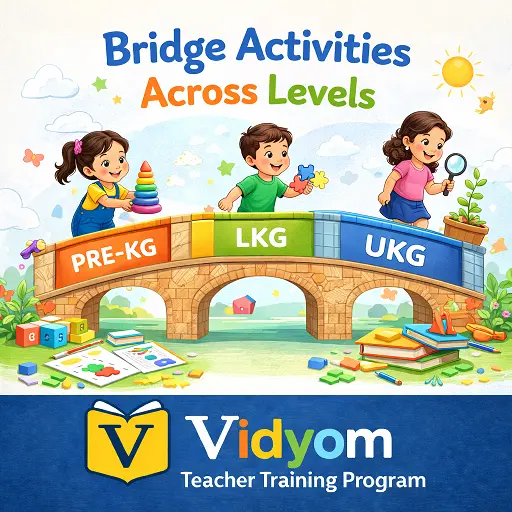
Bridge activities across levels help children move from Pre-KG to LKG and from LKG to UKG with confidence. This lesson shows how teachers can use quick revision, small stretch tasks, readiness checks, mixed-age practice, and simple routines.
This lesson helps teachers support children during level changes. A bridge activity should begin with something familiar, add one small new step, give guided practice, and end with a quick check. This method reduces fear and builds readiness.
Bridge Activities Across Levels for Classroom Readiness
Bridge weeks combine review with a tiny step up. Children first feel successful with known skills, then they try the next level skill in a safe and guided way. Keep tasks short, visual, and hands-on.
- Basic materials: Picture cards, letter tiles, sand trays, ten-frames, counters, simple readers, sequencing strips, sticker code, and observation sheets.
- Teaching flow: Review, micro-teach, guided practice, independent try, and exit check.
- Group size: Keep 4 to 6 children in one table group so the teacher can coach easily.
- Transition signal: Use a chime, next-card visual, and a short tidy song.
- Teacher habit: Praise effort and readiness, not only correct answers.
Pre-KG to LKG Bridge Activities
Pre-KG to LKG bridge activities should build listening, speaking, sound awareness, number sense, fine motor control, and simple classroom independence.
- Phonemic start: Sort objects by first sound using only two sounds at first.
- Letter feel: Air-write, finger-trace in sand, and write three neat copies on a slate.
- Number sense: Show 1 to 5 with fingers or counters and match each group to the numeral.
- Sequence talk: Arrange three pictures and say “first, then, last.”
- Fine motor: Make playdough letter shapes and bead AB patterns.
LKG to UKG Bridge Activities
LKG to UKG bridge activities should help children strengthen blending, segmenting, handwriting control, number writing, ten-frame understanding, and short story retelling.
- Blend and segment: Use three sound tiles for words like sat, pin, map, and tap.
- Sound swap: Change the first or last sound and read the new word.
- Formation boost: Use sky, grass, and ground lines with five neat copies only.
- Number writing: Write 1 to 10 with top-down cues and compare groups quickly.
- Retell practice: Use four picture cards and say two short sentences with then or because.
Mixed-Age Bridge Strategies
In mixed-age groups, use the same activity but change the expected answer. This keeps classroom management simple while giving each level the right challenge.
- Letter task: Pre-KG names the picture, LKG says the first sound, and UKG reads a CVC word.
- Math task: Pre-KG counts 1 to 5, LKG matches 1 to 10, and UKG compares or writes the number.
- Story task: Pre-KG points and names, LKG orders three pictures, and UKG retells with sequence words.
- Classroom jobs: Material leader, time helper, tidy captain, and line leader rotate daily.
- Support method: Give the youngest children picture help and the older children a small extra challenge.
Readiness Checks and Friendly Assessment
Readiness checks should be quick and low-pressure. The goal is to see whether a child can use the skill independently, with support, or after more practice.
- Sticker code: Green means independent, yellow means with help, and red means needs practice.
- Exit checks: Show 7 on a ten-frame, read two CVC words, or trace m, n, and p neatly.
- Family link: Send one picture card for talk-and-point practice at home.
- Move-up sign: Three green checks across a week show stable readiness.
- Teacher note: Write one short line about what the child can do now and what comes next.
Simple Bridge Week Lesson Plan for 40 Minutes
A bridge week timetable should feel familiar but slightly challenging. Keep the new step small and give enough guided practice before the exit check.
- 6 minutes: Review known letters, numbers, pictures, or routines.
- 8 minutes: Micro-teach one small new step.
- 8 minutes: Guided small-group practice with the teacher.
- 8 minutes: Learning centers with level-wise tasks.
- 5 minutes: Exit checks for selected children.
- 5 minutes: Praise, tidy-up, home prompt, and calm close.
Quick Quiz
Choose one option for each question and click Submit.
Teacher Reflection & Practice
After learning about bridge activities across levels, think about how familiar skills, small new challenges, guided practice, mixed-age tasks, and readiness checks can help children move confidently from Pre-KG to LKG and from LKG to UKG.
Which transition needs more support in your classroom right now: Pre-KG to LKG, LKG to UKG, or mixed-age learning where children are working at different readiness levels?
During your next bridge activity, notice whether children can complete the familiar part independently, understand the small new step, use visual or hands-on support, and show readiness during the exit check.
Choose one skill and teach it with a bridge sequence: review something children already know, introduce one small next-level skill, give guided practice, allow an independent try, and finish with one quick readiness check.
Supporting Smooth Learning Transitions
Bridge activities help children move confidently from Pre-KG to LKG and from LKG to UKG by connecting familiar skills with small new challenges. Simple sound games, number activities, tracing practice, picture sequencing, storytelling, and readiness checks help teachers identify learning needs while preparing every child for the next level.
Bridge Activities Across Levels FAQs for Teachers
These simple answers help teachers plan transition activities, readiness checks, mixed-age tasks, Pre-KG to LKG support, and LKG to UKG bridge practice.
What are bridge activities across levels?
Why are bridge activities useful in preschool?
What is a good bridge activity from Pre-KG to LKG?
What is a good bridge activity from LKG to UKG?
How can teachers manage mixed-age bridge activities?
How can teachers check readiness across levels?
📲 Download Vidyom – Kids Learning App
Enjoy safe and distraction-free learning for kids. Install the Vidyom app now for an ad-free experience, fun lessons, and interactive activities.