
Simple Classroom Rules and Routines for Preschool Teachers
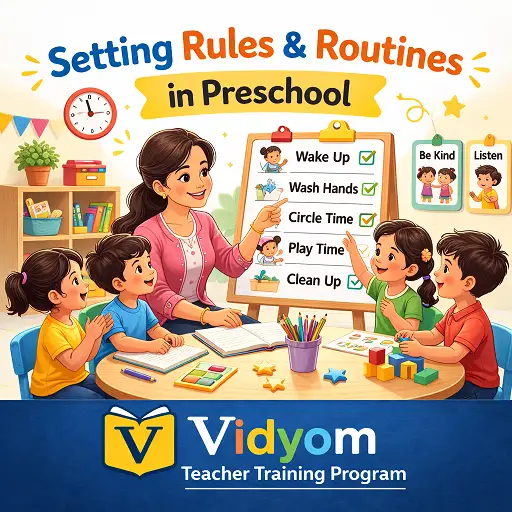
Setting rules and routines in preschool helps children feel safe, understand expectations, move calmly between activities, and spend more time learning. This lesson gives teachers simple rule posters, transition routines, visual supports, and positive praise methods.
This lesson helps teachers build classroom management through short rules, predictable routines, picture-based reminders, and kind correction. When children know what to do next, the class becomes calmer and learning time increases.
Setting Rules and Routines in Preschool for Calm Classrooms
Preschool classroom rules should be few, simple, visual, and practiced every day. A routine works best when the teacher shows the step, models it, lets children practice it, checks quickly, and praises the correct action.
- Basic materials: Rule posters with icons, visual schedule cards, transition song, timer or bell, table signs, line markers, and reward stickers.
- Core signal: Teacher says “1-2-3 eyes on me,” and children answer “eyes on you.”
- Teaching cycle: Show, model, practice, quick check, and praise.
- Class setup: Use whole-class modeling first and small-group practice next.
- Teacher goal: Make expectations clear before behavior problems begin.
Simple Preschool Classroom Rules
Young children remember rules better when they are short and connected with actions. Use only three or four rules and repeat them with gestures.
- Eyes watching: Children look at the teacher, picture card, or activity.
- Ears listening: Children listen when another person is speaking.
- Mouth quiet: Children use quiet voices during listening time.
- Hands gentle: Children use safe hands with friends, books, toys, and materials.
- Daily review: Use a 30-second chant with actions before circle time.
Routines and Transitions for Preschool Children
Routines reduce confusion. Children should know how to arrive, sit, move, tidy, line up, and finish the day. Use the same signals until the steps become automatic.
- Arrival routine: Name card, bag hook, water bottle place, and table task.
- Circle routine: Signal, sit spot, greeting song, rule chant, and first activity.
- Center routine: Timer, work time, cleanup song, reset tray, and move to next place.
- Line-up routine: Call by group, stand on markers, quiet feet, and walking hands.
- Calm finish: Soft song and breathing: “smell the flower, blow the candle.”
Positive Reinforcement and Specific Praise
Positive reinforcement works best when the teacher names the exact action. Children should know which behavior helped the class.
- Specific praise: Say, “I notice Mina is tidying the blocks carefully.”
- Catch early: Praise the first few children who start the routine correctly.
- Group points: Give table stars for tidy trays, quiet line-up, or gentle hands.
- Mini rewards: Helper badge, choose the song, sticker code, or line leader turn.
- Kind correction: Say the expected action again instead of giving a long lecture.
Visual Supports for Rules and Routines
Picture support helps young children remember what to do. Visuals are especially useful during transitions, waiting time, group work, and cleanup.
- Schedule strip: Use five or six picture cards and flip each card after the activity is done.
- Rule icons: Use simple pictures for eyes, ears, mouth, and hands.
- Choice board: Offer two or three calm choices for waiting time.
- Line-up footprints: Use floor markers to reduce pushing and crowding.
- Table signs: Show children where to sit, work, tidy, and keep materials.
Simple Rules and Routines Lesson Plan for 40 Minutes
This sample timetable helps teachers introduce rules and routines through modeling, practice, positive praise, and a calm closing activity.
- 5 minutes: Rules chant and quick wrong-way/right-way model.
- 8 minutes: Arrival to circle routine practice with signal, sit, and listen.
- 10 minutes: Center routine with timer and cleanup song.
- 8 minutes: Positive praise round and table stars.
- 5 minutes: Visual schedule review and line-up practice.
- 4 minutes: Story, breathing, calm finish, and home reminder.
Quick Quiz
Choose one option for each question and click Submit.
Teacher Reflection & Practice
After learning about setting rules and routines in preschool, think about how simple expectations, predictable transitions, visual reminders, positive praise, and kind correction can help children feel safe and manage classroom routines with greater independence.
Which classroom routine needs the most improvement right now: arrival, circle time, learning centers, tidy-up, line-up, transitions, or the calm closing routine?
During your next class, notice whether children understand the rule or routine, respond to the signal, use visual reminders, complete the steps with less prompting, and react positively to specific praise.
Choose one routine and teach it using a simple cycle: show the expected behavior, model it clearly, let children practice, give one quick reminder if needed, and praise the exact action when they do it correctly.
Building a Calm and Organised Classroom
Clear rules and predictable routines help preschool children feel safe, confident, and ready to learn. Simple picture cues, repeated transition signals, gentle reminders, specific praise, and regular practice teach children how to listen, tidy up, move safely, wait for their turn, and complete daily activities independently.
Setting Rules and Routines in Preschool FAQs for Teachers
These simple answers help teachers plan preschool classroom rules, daily routines, transitions, visual schedules, positive praise, and calm behavior support.
What does setting rules and routines in preschool mean?
How many classroom rules should preschool children have?
Why are routines important in preschool classrooms?
How can teachers make transitions smoother?
What is positive reinforcement in preschool?
How do visual schedules help young children?
📲 Download Vidyom – Kids Learning App
Enjoy safe and distraction-free learning for kids. Install the Vidyom app now for an ad-free experience, fun lessons, and interactive activities.