
Preschool Lesson Plan Template for New Teachers
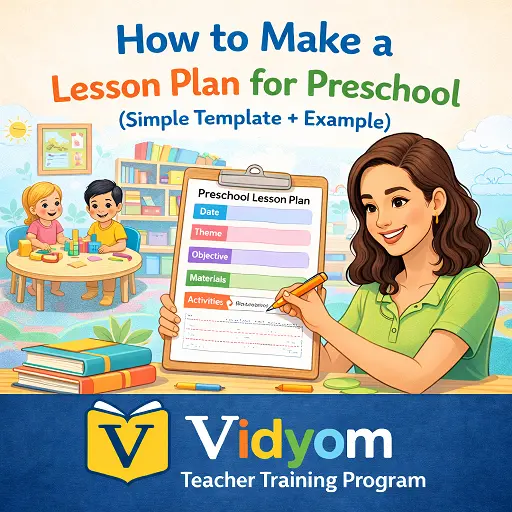
A preschool lesson plan template helps teachers plan objectives, materials, activities, support, and quick checks in one simple structure. This lesson shows how to make a clear daily plan for Pre-KG, LKG, and UKG classes.
This lesson helps teachers plan short, clear, and activity-based preschool lessons. A good plan should show what children will learn, what materials are needed, how the teacher will guide the activity, and how learning will be checked at the end.
Preschool Lesson Plan Template – Overview and Format
A one-page lesson format is best for preschool teachers because it saves time and keeps the lesson focused. The plan should be simple enough to use daily and clear enough for another teacher to understand quickly.
- Topic and Age Group: Write the topic, class level, date, and approximate activity time.
- Learning Objective: Write 1 or 2 child-friendly outcomes, such as name, match, count, trace, or retell.
- Materials: List picture cards, crayons, counters, story cards, trays, or worksheets.
- Lesson Steps: Plan warm-up, new learning, guided practice, activity time, and quick check.
Step-by-Step Lesson Planning for Preschool
Preschool lesson planning should move from easy review to new learning and then to practice. Children learn better when the same simple pattern is repeated every day.
- Warm-up: Spend 2 to 3 minutes reviewing an old topic with actions, cards, or a song.
- New learning: Introduce one new idea with 2 or 3 examples only.
- Guided practice: Do the activity together and support children with prompts and praise.
- Independent or center work: Let children practice with trays, picture cards, matching tasks, or simple worksheets.
- Quick check: End with a short show-me task, yes/no question, matching card, or picture sequence.
Differentiation and Classroom Supports
Not every child learns at the same speed. A good lesson plan includes small support ideas for children who need help and small extension ideas for children who are ready for more.
- Easier support: Use fewer items, bigger pictures, pointing, gestures, and one-word answers.
- On-level task: Ask children to match, trace, name, count, sort, or repeat short lines.
- Extension task: Ask children to say a sentence, explain why, sort by two rules, or retell in order.
- Visual support: Use anchor charts, picture cues, arrows, color cards, and hand actions.
- Language support: Give sentence starters like “I can see…” or “First… then…”.
Creative Teaching Aids for Lesson Planning
Teaching aids make preschool lessons more active and easier to understand. Choose simple materials that children can see, touch, move, or use during the activity.
- Picture cards: Use picture cards for vocabulary, sounds, stories, matching, and sorting.
- Pocket chart: Arrange cards for sequencing, phonics, numbers, or classroom routines.
- Puppets and props: Use puppets to introduce stories, moral values, or conversation practice.
- DIY materials: Use sticks, strings, clay, beads, leaves, cups, or buttons for hands-on learning.
- Activity trays: Prepare small trays for phonics, math, art, fine motor, and story tasks.
Assessment and Quick Checks
Preschool assessment should be simple and gentle. The goal is to understand what the child can do, not to create pressure.
- Observe one skill: Watch one target skill, such as naming, matching, counting, tracing, or listening.
- Exit task: Ask one quick question like “Show me 3” or “Point to the red card.”
- Sticker code: Use simple notes like independent, with help, or needs more practice.
- Parent update: Share one short line about what the child practiced, not a long report.
- Teacher reflection: Write one thing that worked and one thing to improve next time.
Sample 40-Minute Preschool Lesson Plan
This filled example shows how a daily preschool lesson plan can look. You can change the topic, age group, and materials based on your class.
- 3 minutes: Warm-up with a short song and flashcard review.
- 5 minutes: Introduce one new sound, color, shape, number, or story idea.
- 8 minutes: Guided practice using picture cards, counters, or actions.
- 12 minutes: Activity centers for tracing, matching, sorting, counting, or picture sequencing.
- 5 minutes: Quick check with a show-me task or one oral question.
- 7 minutes: Tidy-up, praise, recap, and calm closing routine.
Quick Quiz
Choose one option for each question and click Submit.
Teacher Reflection & Practice
After learning how to use a preschool lesson plan template, think about how clear objectives, simple lesson steps, suitable teaching aids, child-friendly support, and quick assessment can make daily teaching more organized and effective.
Which part of lesson planning is most difficult for you: writing a clear objective, choosing materials, planning activity steps, supporting different learning levels, managing time, or deciding how to check learning?
During your next preschool lesson, notice whether children understand the objective, follow the activity steps, use the teaching aids successfully, and complete the task independently or with support. Also notice which part of the lesson takes more or less time than planned.
Create one simple one-page lesson plan with one clear learning objective, required materials, a short warm-up, new learning, guided practice, activity time, one support or extension idea, and a quick show-me or oral check at the end.
Planning Meaningful Preschool Learning
A clear preschool lesson plan helps teachers organise learning objectives, materials, warm-up activities, guided practice, play-based tasks, assessment, and reflection. Short, age-appropriate steps make lessons easier to manage while keeping children active, interested, and supported throughout the learning experience.
Preschool Lesson Plan Template FAQs
These simple answers help teachers prepare daily preschool lesson plans with objectives, materials, activity steps, support ideas, and quick assessment.
What is a preschool lesson plan template?
What should be included in a preschool lesson plan?
How long should a preschool lesson plan activity be?
How can teachers write clear learning objectives?
How should preschool teachers assess learning?
Can the same lesson plan format be used for Pre-KG, LKG and UKG?
📲 Download Vidyom – Kids Learning App
Enjoy safe and distraction-free learning for kids. Install the Vidyom app now for an ad-free experience, fun lessons, and interactive activities.