
Storytelling and Circle Time Management – Preschool Teacher Guide
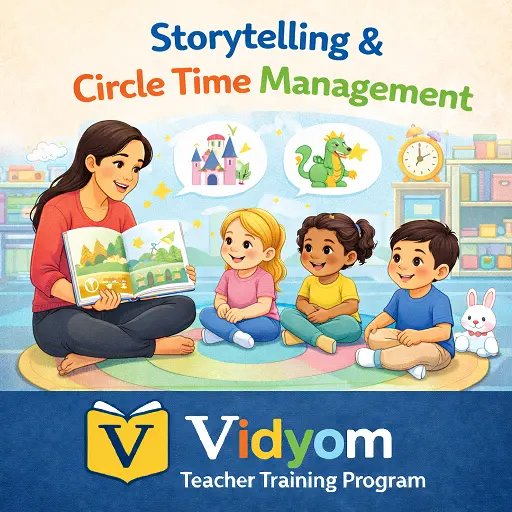
Storytelling and circle time management becomes easier when teachers use clear seating, simple signals, picture cues, action words, short turns, and quick checks. This lesson helps teachers keep every child focused, happy, and involved during storytime.
This lesson helps teachers plan calm circle time with story props, attention signals, role cards, picture walks, echo lines, movement breaks, and simple retelling tasks. A good storytime routine builds listening, speaking, vocabulary, memory, and confidence.
Storytelling and Circle Time Management with Simple Materials
Storytime works best when children know where to sit, when to listen, when to speak, and how to join. Keep the routine short, visual, active, and predictable.
- Materials: Big book, picture cards, puppet, prop bag, signal chime, role cards, and retell strip.
- Time: Use short blocks of 8 to 10 minutes with a stretch break when needed.
- Rules: Eyes on picture, hands in lap, listening ears, and speak on signal.
- Flow: Warm-up chant, picture walk, story reading, action cue, retell, and quick check.
- Teacher goal: Keep children listening, speaking, moving, and thinking in a calm circle routine.
Seating and Attention Signals for Circle Time
Clear seating and attention signals help children settle quickly. Use the same signal every day so children understand what to do without long reminders.
- Circle spots: Use dots, tape squares, or mats to show each child’s place.
- Signal: Chime, teacher hand up, children freeze, then echo “ready.”
- Jobs: Page-turn helper, prop giver, echo leader, picture holder, and tidy helper.
- Reset: Use a 20-second stretch: reach, shake, breathe, and sit.
- Support: Seat children who need help closer to the teacher or beside a calm peer.
Story Flow with Predictable Steps
A predictable story flow keeps children engaged because they know what comes first, next, and last.
- Picture walk: Preview four to six pictures and ask children to predict one word.
- Echo lines: Teacher says a short line, and children echo with a gesture.
- Action cues: Clap, tap, point, jump, whisper, or freeze for key story verbs.
- Turn and tell: Pairs say “First…” and “Then…” in one simple sentence.
- Retell strip: Children place four pictures in order and retell the main idea.
Engagement Tools for Active Storytime
Young children need movement, voice play, visuals, and short turns. These tools help teachers balance energy during storytime.
- Puppet support: The puppet whispers the clue or asks a simple question.
- Prop bag: Children pull one safe prop and connect it to the story.
- Voice play: Use whisper voice, robot voice, animal voice, or soft echo voice.
- Action words: Children act out jump, sleep, eat, run, hide, look, and clap.
- Choice close: Children draw one scene or act one small part in pairs.
Quick Checks for Listening and Understanding
Quick checks should be short. They help the teacher know who understood the story and who needs more support.
- Thumb check: Ask, “Was the cat first?” Children show thumbs up or down.
- Show me: Children point to a picture, character, place, or action card.
- Who/where: Ask one “who” and one “where” question to a few children.
- Sound start: Ask children to say the first sound of a story word.
- Sticker code: Green means independent, yellow means with help, and red means more practice.
Simple 40-Minute Storytelling and Circle Time Plan
This sample timetable helps teachers keep the circle time structured, playful, and easy to manage.
- 6 minutes: Seating, signal practice, and warm-up chant.
- 10 minutes: Story read-aloud with echo lines and actions.
- 8 minutes: Turn and tell with picture support.
- 8 minutes: Retell strip and prop-based story talk.
- 5 minutes: Quick checks for who, where, and first sound.
- 3 minutes: Praise, tidy song, and calm closing routine.
Quick Quiz
Choose one option for each question and click Submit.
Teacher Reflection & Practice
After learning about storytelling and circle time management, think about how clear seating, consistent attention signals, picture cues, short movement breaks, active story participation, and quick understanding checks can make circle time calmer and more engaging.
Which part of your current circle time is hardest to manage: settling children, keeping attention, giving fair speaking turns, maintaining story interest, handling restlessness, or checking understanding?
During your next story session, notice when children begin to lose attention, which seating or signal supports help them refocus, who participates confidently, and who responds better to pictures, gestures, props, movement, or short partner talk.
Plan one storytime using a clear seating signal, short picture walk, echo line, action cue, turn-and-tell activity, simple retell task, and one quick check. Add a brief movement reset before children become restless.
Making Storytime Active and Engaging
Well-planned storytelling and circle time help preschool children develop listening, vocabulary, imagination, confidence, and social skills. Teachers can use picture walks, puppets, expressive voices, action cues, short movement breaks, simple questions, and retelling activities to keep children focused and involved in a calm group routine.
Storytelling and Circle Time Management FAQs for Teachers
These simple answers help teachers plan preschool storytime, circle seating, attention signals, picture walks, action cues, retelling, and quick listening checks.
What is storytelling and circle time management?
How long should preschool circle time be?
How can teachers get children’s attention during storytime?
What is a picture walk in storytelling?
How can teachers keep children engaged in circle time?
How can teachers check story understanding quickly?
📲 Download Vidyom – Kids Learning App
Enjoy safe and distraction-free learning for kids. Install the Vidyom app now for an ad-free experience, fun lessons, and interactive activities.