
Group Activities vs Individual Learning – Preschool Teacher Guide
Group activities vs individual learning becomes easier to manage when teachers choose the right activity mode for the right goal. This lesson explains group work, quiet solo practice, small rotations, classroom roles, quick checks, and balanced preschool learning.
This lesson helps teachers decide when to use group learning and when to use individual learning. A balanced preschool class gives children time to talk, share, cooperate, focus, practice, and get short one-to-one support from the teacher.
Group Activities vs Individual Learning for Balanced Preschool Lessons
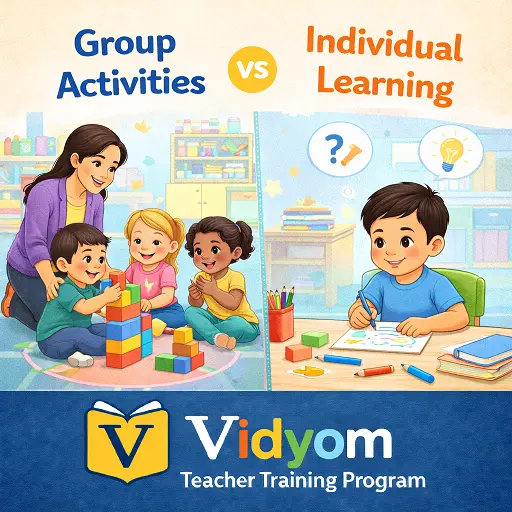
A good preschool lesson does not use only group work or only solo work. Group activities help children talk, listen, share, and learn from friends. Individual activities help children focus, practice, and show what they can do.
- Materials: Role cards, picture task cards, sand timers, quiet-choice menu, table trays, signal chime, and simple observation sheet.
- Classroom zones: Carpet area, table teams, quiet corner, teacher table, and material shelf.
- Teacher signal: Hand up, soft chime, children freeze, then one short instruction.
- Basic flow: Mini lesson, group or individual task, teacher check, praise, and quick reset.
- Teacher goal: Match the activity format to the learning goal, child need, and attention level.
When to Use Group Activities in Preschool
Group activities are useful when the learning goal needs talking, listening, turn-taking, sharing, teamwork, movement, or peer modeling.
- Language learning: Picture talk, show-and-tell, story retelling, and vocabulary games.
- Social skills: Sharing toys, taking turns, helping friends, and listening to others.
- Creative work: Group collage, block building, pretend play, action songs, and sorting games.
- Peer modeling: Stronger children can model steps while quieter children watch and join slowly.
- Teacher role: Set clear roles, watch participation, and support kind language.
When to Use Individual Learning in Preschool
Individual learning is useful when children need quiet focus, fine-motor practice, independent thinking, personal pace, or teacher one-to-one support.
- Fine-motor practice: Tracing, coloring, cutting, letter formation, and number writing.
- Focus tasks: Matching cards, puzzle mats, ten-frame building, pattern practice, and picture sorting.
- Confidence building: Some children answer better alone before sharing in a group.
- Teacher support: Give short prompts, model once, wait, and praise effort.
- Quiet choices: Books, drawing, sensory bins, shape puzzles, or simple worksheet practice.
Rotations and Classroom Roles
Rotations help teachers balance group activities and individual learning inside one lesson. Children move through different stations while the teacher supports one group closely.
- Three stations: Teacher table, team task, and quiet-choice activity.
- Roles: Leader starts the task, helper manages materials, reader checks the card, and reporter shares the result.
- Timing: Use 8 to 10 minutes per station with a 30-second tidy song.
- Fair turns: Change roles after every rotation so one child is not always the leader.
- Calm movement: Rotate clockwise using table arrows or color signs.
Quick Checks and Simple Observation Data
Quick checks help teachers know who needs group support, who needs individual help, and who is ready for a small challenge.
- Show me check: Children show a letter, number, shape, or answer card.
- Two-item exit: Ask the child to circle one sound or build one number with counters.
- Sticker code: Green means independent, yellow means with help, and red means more practice needed.
- Next step: Move the child to peer support, teacher table, quiet practice, or extension task.
- Observation note: Write one short line about what helped the child participate.
Simple 40-Minute Group and Individual Learning Plan
This sample timetable gives children time for a mini lesson, group work, solo practice, rotations, and quick checks.
- 6 minutes: Mini lesson and signal practice.
- 8 minutes: Group activity with roles and teacher language support.
- 8 minutes: Individual practice with quiet choices.
- 10 minutes: Station rotation: teacher table, team task, and quiet corner.
- 5 minutes: Quick checks and observation notes.
- 3 minutes: Praise, tidy-up, and calm closing routine.
Quick Quiz
Choose one option for each question and click Submit.
Teacher Reflection & Practice
After learning about group activities vs individual learning, think about how choosing the right activity format, using fair classroom roles, planning short rotations, and checking children’s progress can create a more balanced preschool lesson.
Which parts of your current lessons work better as group activities, and which skills need more individual practice or one-to-one teacher support?
During your next lesson, notice which children participate confidently in groups, who focuses better alone, whether classroom roles are shared fairly, and which children need teacher-table support, quiet practice, peer help, or an extra challenge.
Plan one balanced lesson with a short mini lesson, one group activity, one individual task, and a simple rotation. Finish with a quick check so you can decide each child’s next step based on participation and learning.
Balancing Teamwork and Independent Practice
Group Activities vs Individual Learning FAQs for Teachers
These simple answers help teachers balance preschool group work, individual practice, peer learning, quiet tasks, rotations, teacher support, and quick classroom checks.
What does group activities vs individual learning mean?
When should teachers use group activities?
When should teachers use individual learning?
How can teachers balance group and individual learning?
What is a good preschool rotation plan?
How can teachers check whether children need group or individual support?
📲 Download Vidyom – Kids Learning App
Enjoy safe and distraction-free learning for kids. Install the Vidyom app now for an ad-free experience, fun lessons, and interactive activities.