
Teaching Numbers and Early Math with Hands-on Activities
Teaching numbers and early math becomes easier when children count real objects, show numbers on ten-frames, compare groups, make patterns, and connect symbols with meaning. This lesson gives teachers a simple classroom routine for number sense and preschool math.
This lesson helps teachers plan early math teaching in small steps. Children first touch and count objects, then use pictures or ten-frames, and finally read or write numbers. Short practice, clear math words, and quick checks help children build confidence.
Teaching Numbers and Early Math for Classroom Practice
A good early math lesson moves from concrete objects to pictures and then to symbols. Children should touch, count, move, compare, sort, build, and talk before they write numbers or solve sums. This keeps preschool math meaningful and active.
- Basic materials: counters, linking cubes, ten-frames, number cards, number line, shape cards, pattern beads, bowls, and ruled sheets.
- Daily routine: Review known numbers, introduce one small idea, use objects, show with pictures, write briefly, and check quickly.
- Learning order: Concrete objects first, picture support next, and written symbols after understanding.
- Math language: Use words like count, match, more, less, same, before, after, between, pattern, shape, and how many.
- Teacher habit: Ask children to explain with words, fingers, counters, or pictures, not only with written answers.
Number Sense with Objects and Ten-Frames
Number sense means understanding what a number really means. Children need to count objects, match numbers to quantities, see groups quickly, and understand that the last counted number tells the total.
- Touch-count: Move one counter for each number said so children connect words with objects.
- Ten-frame show: Place counters on a ten-frame and say, “five and two make seven.”
- Match practice: Match numeral cards with objects, finger patterns, and dot cards.
- Subitizing: Flash 3 to 5 dots quickly and ask, “How many?”
- Number talk: Ask “How do you know?” so children explain their thinking.
Number Writing from Big to Small
Number writing becomes easier when children first use large movements. They should air-write, trace, use trays, write on slates, and then practice neatly on ruled pages.
- Air writing: Make the number in the air using a big hand movement.
- Finger tracing: Trace a thick number card or sand tray with the index finger.
- Slate practice: Write slowly with start dots and teacher stroke prompts.
- Ruled page: Move to neat notebook writing only after the stroke direction is clear.
- Neat five: Five careful numbers are better than many rushed numbers.
Compare, Order and Pattern Activities
Comparing and pattern work build logical thinking. Children learn these ideas better when they build towers, arrange cards, sort objects, and explain what comes next.
- More or less: Build two towers and ask which tower has more, less, or the same.
- Number order: Place number cards 1 to 10 and ask children to find before, after, and between.
- AB pattern: Make red-blue-red-blue using beads, blocks, or picture cards.
- ABC pattern: Use three objects or colors, then let children continue the pattern.
- Explain the rule: Ask children to say the pattern rule in simple words.
Shapes and Spatial Math Skills
Shapes and spatial words help children understand the world around them. Use real classroom objects, body movement, and simple building tasks before worksheets.
- Shape revision: Revise circle, square, and triangle before adding rectangle and oval.
- Shape hunt: Ask children to find classroom objects that match one shape.
- Build shapes: Make shapes with sticks, strings, blocks, or clay.
- Spatial words: Practice inside, outside, above, below, near, far, front, and behind.
- Sort and name: Sort objects by shape, size, or color and let children explain the group.
Simple Early Math Lesson Plan for 40 Minutes
A short math timetable keeps the class active. It gives children time to count, write, compare, make patterns, and explain their ideas.
- 6 minutes: Number warm-up with counters, fingers, and number cards.
- 6 minutes: Ten-frame activity and numeral-to-quantity matching.
- 6 minutes: Number writing using air, tray, slate, and neat five practice.
- 7 minutes: Compare towers for more, less, and same.
- 7 minutes: Pattern building with beads, blocks, or picture cards.
- 8 minutes: Quick check, shape hunt, praise, and tidy-up routine.
Quick Quiz
Choose one option for each question and click Submit.
Teacher Reflection & Practice
After learning about teaching numbers and early math, think about how counting objects, ten-frames, number writing, comparing, patterns, shapes, and simple math language can help children understand numbers with confidence.
Which early math skill needs more support in your classroom: counting objects, matching numbers to quantities, number writing, comparing groups, making patterns, or recognizing shapes?
During your next math activity, notice whether children can touch and count accurately, explain how many objects they see, match quantities with numerals, and use words such as more, less, same, before, and after.
Choose one number or math idea and teach it in three steps: begin with real objects, show the same idea with pictures or a ten-frame, and then connect it to the written number or symbol.
Making Early Math Meaningful and Fun
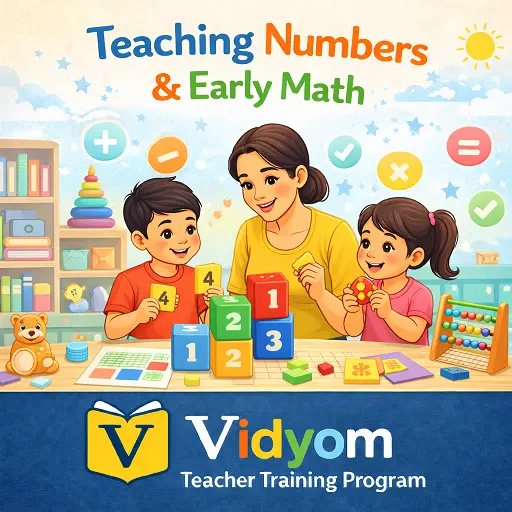
Teaching Numbers and Early Math FAQs for Teachers
These simple answers help teachers plan number sense, counting, number writing, comparison, patterns, shapes, and hands-on early math activities.
What does teaching numbers and early math mean?
What is the best way to start number teaching?
Why is number sense important for young children?
How should teachers teach number writing?
How can teachers make early math fun?
Should preschool children do long math worksheets?
📲 Download Vidyom – Kids Learning App
Enjoy safe and distraction-free learning for kids. Install the Vidyom app now for an ad-free experience, fun lessons, and interactive activities.