
Teaching Letters and Phonics the Right Way for Early Reading Skills
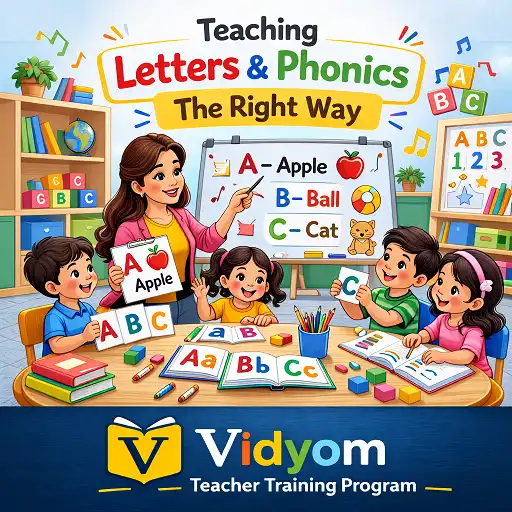
Teaching letters and phonics the right way means helping children connect sounds, letters, blending, segmenting, handwriting, words, and short sentences through simple multisensory practice. This lesson gives a clear classroom routine for preschool and kindergarten teachers.
This lesson helps teachers plan phonics teaching in small steps. Children should hear the sound, see the letter, say the sound, build the word, write neatly, and read back with confidence. Short practice cycles work better than long copying tasks.
Teaching Letters and Phonics the Right Way – Overview
A strong phonics lesson moves from sound to print in a clear order. Children first listen, then say the sound, connect it to a letter, blend or segment a word, and finally write or read it. This method supports phonemic awareness, early reading, and handwriting confidence.
- Basic materials: picture sound cards, letter cards, chips, counters, magnetic letters, sand trays, ruled boards, word cards, and sentence strips.
- Daily routine: Review old sounds, introduce one new sound or pattern, guide practice, check quickly, and praise effort.
- Learning order: Hear the sound, say it clearly, match the letter, build the word, write the word, and read back.
- Class grouping: Start with whole-class practice, then use small groups for blending, writing, and quick checks.
- Teacher habit: Keep correction gentle and specific, such as “start at the top” or “listen to the first sound again.”
Sounds, Blending and Segmenting
Blending means joining sounds to read a word. Segmenting means breaking a word into sounds for spelling. Children understand both skills better when they use actions, picture cards, and small objects.
- Sound warm-up: Say known sounds with actions, such as /m/ with hand near mouth or /s/ with snake arm.
- One focus sound: Choose one sound, blend, or digraph and show clear picture examples.
- Picture sorting: Sort 4 to 6 pictures into yes or no groups for the focus sound.
- Blend with chips: Push chips together for words like sun, map, fish, clap, or ship.
- Segment slowly: Pull the chips apart and let children say each sound clearly.
Letter Formation and Handwriting Readiness
Letter formation becomes easier when children learn the starting point, direction, and line position. Move from big movements to small writing, so the hand is ready before notebook work.
- Air writing: Draw the letter in the air with a big arm movement.
- Finger tracing: Trace a thick letter card or sand tray before writing on paper.
- Line support: Use sky, grass, and ground lines to show where letters sit.
- Simple prompts: Say “top down,” “around and close,” or “down, across, down.”
- Neat five: Five slow and neat letters are better than many rushed letters.
From Letters to Words and Sentences
After children know sounds and letter shapes, they should build short words and read them back. Sentence practice should begin with simple starters and clear punctuation.
- Build words: Tap the sounds, arrange letter cards, read the word, and then write it.
- Use CVC words: Start with simple words like mat, sun, pin, tap, and net.
- Add digraph words: Slowly add words like ship, fish, chop, chat, and thin.
- Sentence starters: Use “I can…”, “We see…”, “It is…”, and “This is…”.
- Read back: Ask children to point and read their word or sentence aloud.
Phonics Learning Centers
Learning centers give children repeated practice without long waiting time. Keep materials ready, explain the rules, and rotate groups with a short timer.
- Sound sort: Sort objects or pictures by beginning sound.
- Build and write: Build one word with magnetic letters and copy it neatly.
- Sand tray: Trace the focus letter or word using a finger.
- Sentence strip: Choose a starter and complete one short sentence.
- Read to partner: Read one word card or sentence strip to a friend.
Simple Phonics Lesson Plan for 40 Minutes
A short phonics timetable helps teachers balance listening, speaking, reading, writing, and practice. Keep each part active and avoid long copying work.
- 6 minutes: Sound warm-up and one new focus sound or pattern.
- 6 minutes: Picture sorting and oral sound practice.
- 6 minutes: Blend and segment with chips or counters.
- 6 minutes: Letter formation using air writing, tracing, and slate practice.
- 8 minutes: Word building, sentence starter, and read-back practice.
- 8 minutes: Learning centers, quick check, praise, and tidy-up song.
Quick Quiz
Choose one option for each question and click Submit.
Teacher Reflection & Practice
After learning about teaching letters and phonics the right way, think about how listening, sound practice, blending, letter formation, word building, and short reading activities can work together to build early reading confidence.
Which part of your phonics teaching needs more attention: hearing sounds, saying sounds clearly, blending, segmenting, letter formation, word building, or reading back?
During your next phonics lesson, notice which children can hear and identify the focus sound, blend sounds into words, form letters correctly, and read their words back with confidence.
Choose one sound and follow a simple sequence: hear it, say it, match it to the letter, blend or segment a word, build the word, write it, and finally read it aloud.
Building Strong Early Reading Skills
Children learn letters and phonics best when they can hear sounds, connect them with written letters, blend simple words, and practise correct letter formation. Short, playful activities using pictures, actions, sound games, tracing, and word building help children become confident early readers and writers.
Teaching Letters and Phonics the Right Way – FAQ
These simple answers help teachers plan letter sounds, blending, segmenting, handwriting, word building, and early reading practice.
What does teaching letters and phonics the right way mean?
Should teachers teach letter names or letter sounds first?
What is the best order for a phonics lesson?
How can teachers teach blending to young children?
Why is letter formation important in phonics?
How much writing should preschool children do during phonics practice?
📲 Download Vidyom – Kids Learning App
Enjoy safe and distraction-free learning for kids. Install the Vidyom app now for an ad-free experience, fun lessons, and interactive activities.