Teaching Pre-KG Basics (Colors, Shapes, Rhymes)
Introduce colors, simple shapes, and starter rhymes using picture cues, songs, movement, and tiny repeat practice.
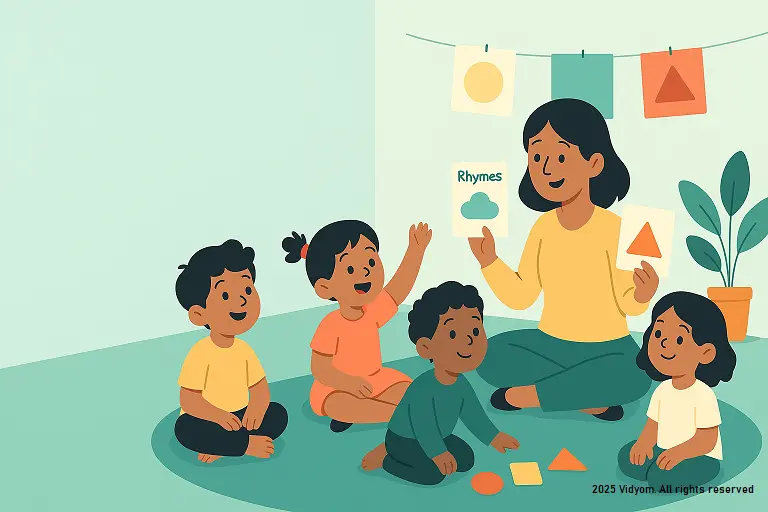
Teaching pre-kg basics works best with short, fun routines—show, say, and do. Moreover, a steady structure keeps children relaxed and ready. In this guide you’ll get ready-to-use steps for teaching pre-kg basics in colors, shapes, and rhymes; as a result, practice feels playful and quick.
Overview & Materials
To begin, gather the core materials and set a simple routine. Next, use short 10–12 minute bursts and rotate groups so attention stays high. Finally, keep transitions cheerful to maintain flow and reduce stress. Additionally, offer quick water breaks so energy returns smoothly.
- Materials: color cards, shape cards (circle/square/triangle), crayons, sorting bowls, music player.
- Routine: show → say → do (picture → chant → action).
- Time: quick bursts with movement between segments.
- Grouping: whole-class intro, small-group practice, quick check.
Teaching Colors
First, make colors loud and physical. Then, confirm understanding with a speedy check. Afterwards, end with specific praise that names the action; therefore, success becomes clear and memorable. Besides, rotate leaders so more children speak.
- Show: hold up red/blue/green cards; name and point.
- Say: chant “red-red-red” (clap), “blue-blue-blue” (tap), “green-green-green” (snap).
- Do: color hunt—find one object of each color in the room.
- Next, sort: place colored blocks into matching bowls.
- Finally, check: point-and-name quick round; then give specific praise.
Teaching Shapes
Because young children learn through movement, begin with large gestures. Afterward, add touch and building so ideas stick. Consequently, shape words connect to actions and remain memorable. Furthermore, review yesterday’s shapes before adding a new one.
- Big gestures: draw air-shapes with arms (circle, square, triangle).
- Touch & trace: trace thick outline cards with fingers.
- Match game: find classroom items that match each shape.
- Build: use sticks/strings to make simple shapes on mats.
Teaching Rhymes (Action + Picture Cues)
Next, turn language into rhythm. As a result, attention rises and words repeat naturally. Meanwhile, picture cues keep the sequence clear and friendly. Moreover, invite a small echo group to lead the rest.
- Picture line: 4–6 images that match the rhyme sequence.
- Action words: add claps, taps, or jumps for key words.
- Echo: teacher one line, children echo; then all together.
- Voice fun: whisper/robot/animal voice to repeat.
Hands-on Activities
Additionally, mix quick games so practice feels fresh. However, keep rules short and concrete. Therefore, every child gets a turn to succeed. Likewise, rotate materials so waiting time stays low.
- Color Collage: glue only red items on a page (magazine cutouts).
- Shape Stomp: floor shapes—call a shape; kids stomp/stand on it.
- Rainbow Train: kids hold color cards and line up in order.
- Rhyme Circle: pass a picture; say the next line when you get one.
Mini Timetable (Sample 40 minutes)
Finally, use this compact sequence. Importantly, keep transitions brief and joyful. This way, momentum continues and attention stays high. In addition, finish with a calm song to reset the class.
- 5 min — Color show–say–do + quick hunt
- 6 min — Shape gestures + trace + match
- 6 min — Rhyme (echo + actions)
- 8 min — Stations: Sort colors | Build shapes | Picture sequence
- 5 min — Quick check + specific praise
- Finally, 10 min — Free play with color/shape baskets (optional extension)
Quick Quiz (5 Questions)
Choose one option for each question and click Submit.

📲 Download VIDYOM App
Fun & interactive Kids Learning App! Install now and don’t forget to ⭐ rate us on Google Play.