
LKG Curriculum Step by Step for New Teachers
LKG curriculum step by step planning helps teachers organize phonics, letter formation, early math, stories, rhymes, and learning centers in a simple classroom routine. This lesson gives a practical LKG syllabus flow with short activities, quick checks, and play-based learning.
This lesson helps teachers plan the LKG curriculum in clear daily steps. Children at this level need letter-sound practice, number sense, drawing, writing readiness, story talk, rhyme actions, and hands-on centers. A steady routine helps children learn with confidence.
LKG Curriculum Step by Step – Overview and Materials
LKG children are ready for more structured learning than Pre-KG, but lessons should still stay short and active. A good LKG curriculum includes phonics, letter writing, early math, stories, rhymes, drawing, oral language, and hands-on practice.
- Basic materials: alphabet strips, phonics picture cards, slate boards, sand trays, crayons, counters, number cards, story cards, and rhyme posters.
- Daily routine: Review old learning, introduce one small new idea, guide practice, check quickly, and praise effort.
- Class grouping: Start with whole-class teaching, then use small groups for phonics, writing, math, and story work.
- Learning balance: Mix literacy and numeracy with art, movement, conversation, and play-based learning.
- Teacher habit: Keep instructions short, repeat key words, and observe each child’s progress.
Phonics and Letter Formation
Phonics helps children connect sounds with letters. Begin with a few letters at a time, then use picture cards, oral practice, blending games, and simple writing practice.
- Sound warm-up: Show a letter card, say the sound, and let children repeat with an action.
- Picture link: Use simple pictures such as mat, mug, sun, tap, pin, or net for beginning sounds.
- Blend and segment: Use counters or blocks to show each sound in a short word.
- Large-to-small writing: Air-write first, then finger trace, then slate practice, then notebook practice.
- Quick check: Show three pictures and ask children to choose the one that starts with the focus sound.
Early Math for LKG Children
Early math should move from concrete objects to pictures and then to symbols. Children understand numbers better when they count, touch, compare, sort, and build before writing.
- Number sense: Count objects, match number cards with quantities, and show numbers using fingers or counters.
- Number writing: Practice 1 to 10 first using air writing, tracing, slate work, and short notebook practice.
- Compare: Use towers, beads, or blocks to show more, less, and same.
- Patterns: Make AB and ABC patterns with beads, blocks, leaves, or picture cards.
- Shapes: Revise circle, square, and triangle, then add rectangle, oval, and simple object matching.
Stories and Rhymes for Language Growth
Stories and rhymes build vocabulary, listening, memory, expression, and confidence. Use picture cards and repeated phrases so children can join even when they cannot read yet.
- Picture walk: Show 4 to 6 pictures before reading or telling the story.
- Echo lines: Say one short line and let children repeat with actions.
- Sequence cards: Ask children to arrange pictures in the correct order.
- Simple retell: Help children say, “First… then… finally…” in one or two sentences.
- Word basket: Let children pick one picture and say the first sound or the full word.
Learning Centers for LKG Classroom Activities
Learning centers make practice active and independent. Set clear rules, use short rotations, and keep materials ready before the lesson starts.
- Phonics center: Sort small objects or cards by beginning sound.
- Writing center: Trace letters in sand, salt, or on a slate before notebook practice.
- Math center: Build numbers with counters, blocks, or ten-frame cards.
- Story corner: Arrange picture cards and retell a short story to a partner.
- Art link: Draw or color one object connected to the day’s letter, number, or story.
Simple LKG Lesson Plan for 40 Minutes
A short timetable keeps the class balanced. It also helps teachers avoid too much writing and gives children time to speak, move, count, trace, and think.
- 6 minutes: Phonics warm-up and one focus sound.
- 6 minutes: Picture sorting and simple sound blending.
- 6 minutes: Letter formation using air, finger tracing, slate, and notebook.
- 8 minutes: Early math activity with counting, comparing, or number writing.
- 8 minutes: Learning centers for phonics, writing, math, and story practice.
- 6 minutes: Quick check, praise, tidy-up song, and calm closing.
Quick Quiz
Choose one option for each question and click Submit.
Teacher Reflection & Practice
After learning the LKG curriculum step by step, think about how phonics, early math, stories, writing readiness, and learning centers can be organized into short and balanced classroom routines.
Which part of your LKG routine needs better balance between teacher instruction, hands-on practice, speaking, movement, writing, and play?
During your next class, notice how children respond to phonics practice, letter formation, counting activities, story work, and learning-center rotations.
Choose one lesson and follow a simple sequence: review old learning, introduce one small new concept, give hands-on practice, check understanding quickly, and finish with positive feedback.
A Clear Learning Path for LKG Children
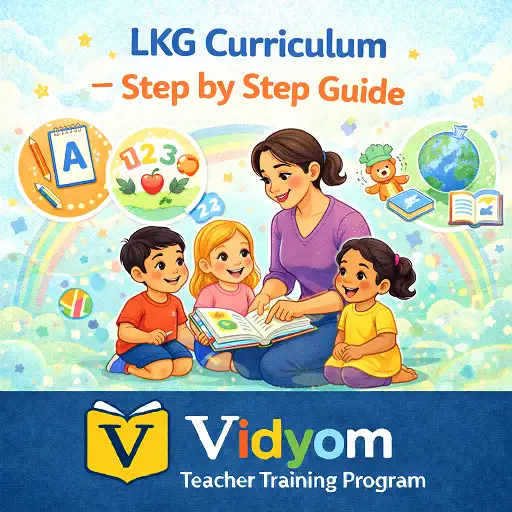
LKG Curriculum Step by Step FAQs for Teachers
These simple answers help teachers plan LKG phonics, letter writing, early math, stories, rhymes, learning centers, and classroom routines.
What does lkg curriculum step by step mean?
What should be included in an LKG curriculum?
How should teachers start an LKG phonics lesson?
How should early math be taught in LKG?
Why are learning centers useful in LKG?
How long should an LKG lesson activity be?
📲 Download Vidyom – Kids Learning App
Enjoy safe and distraction-free learning for kids. Install the Vidyom app now for an ad-free experience, fun lessons, and interactive activities.