
Assessing Learning Pre-KG LKG UKG with Gentle Tools
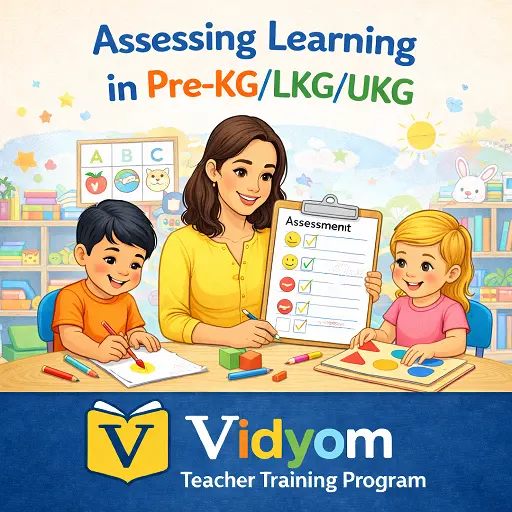
Assessing learning pre-kg lkg ukg should be simple, friendly, and based on daily classroom evidence. This lesson shows teachers how to use observations, checklists, oral checks, work samples, and simple progress notes without creating pressure for young children.
This lesson helps teachers assess preschool learning through everyday routines. Instead of long tests, teachers can observe one skill, write short notes, collect work samples, and use simple ratings like independent, with help, and needs practice.
Assessing Learning Pre-KG LKG UKG – Overview and Tools
Preschool assessment should show what children can do during real activities. Teachers can use daily observation, quick oral checks, picture tasks, matching cards, counting trays, and short notes to understand progress.
- Keep it gentle: Use daily classroom moments instead of stressful tests.
- Check one skill: Focus on one skill at a time, such as sound naming, counting, tracing, matching, or retelling.
- Use simple ratings: Mark progress as independent, with help, or needs practice.
- Record quickly: Write one short note or tick one checklist item during centers.
- Share clearly: Give parents one simple progress line and one small home practice idea.
Observation Techniques for Preschool Assessment
Observation is one of the best assessment methods for young children. Teachers can watch how children listen, speak, count, draw, trace, sort, join group work, and solve small problems.
- Anecdotal note: Write date, skill, child action, and one short teacher note.
- Tally marks: Count how many times a child identifies a sound, counts objects, or follows a direction.
- Photo evidence: Save a photo of a block pattern, ten-frame, drawing, or sorted tray when allowed by school policy.
- Focus group: Observe 5 to 6 children per day, then cover the whole class across the week.
- Skill rotation: Rotate between language, math, fine motor, social habits, and listening skills.
Checklists and Simple Ratings
A checklist should be short and easy to use. It should help the teacher plan next steps, not become extra paperwork.
- Choose 4 to 6 indicators: Use clear actions like names letters, counts 1 to 10, traces lines, retells pictures, or follows two-step directions.
- Use simple codes: Write I for independent, H for with help, and P for needs practice.
- Check during centers: Observe children while they work with cards, counters, stories, or tracing trays.
- Group by need: Use the checklist to make small support groups for the next lesson.
- Review weekly: Update progress once a week instead of trying to score every child every day.
Oral Checks and Friendly Quizzes
Oral checks are useful for preschool because children can answer with words, pointing, actions, objects, or pictures. Keep the check short and encouraging.
- Phonics check: Show four pictures and ask the child to say the first sound.
- Math check: Show seven counters and ask the child to count, match, or make the same number.
- Story check: Show three picture cards and ask the child to arrange and retell them.
- Language check: Ask the child to name objects, describe a picture, or answer a simple question.
- Positive feedback: Say what the child did well and give one small next step.
Work Samples and Mini Rubrics
Work samples help teachers and parents see real progress over time. Save only useful samples so the portfolio stays simple.
- Save two samples monthly: Keep one language sample and one math or fine motor sample.
- Add details: Write date, activity name, level of support, and one short note.
- Use a mini rubric: 0 means not yet, 1 means with help, and 2 means independent.
- Compare gently: Compare the child’s current work with their own earlier work, not with other children.
- Share progress: Use samples during parent meetings to show growth clearly.
Sample 40-Minute Preschool Assessment Cycle
A short assessment cycle can be added to a normal lesson without stopping the flow of learning. The teacher observes while children work.
- 6 minutes: Warm-up and introduce the target skill.
- 10 minutes: Center rotation 1 while the teacher observes group A.
- 10 minutes: Center rotation 2 while the teacher observes group B.
- 8 minutes: Friendly oral checks with 4 to 5 children.
- 4 minutes: Mark checklist codes and save one useful work sample.
- 2 minutes: Write one next-step note for planning the next class.
Quick Quiz
Choose one option for each question and click Submit.
Teacher Reflection & Practice
After learning about assessing learning pre-kg lkg ukg, think about how simple observations, short checklists, friendly oral checks, work samples, and clear progress notes can help you understand children’s learning without creating pressure.
Which part of assessment is most difficult for you: choosing one clear skill, observing children during activities, writing quick notes, using simple rating codes, giving oral checks, or keeping useful work samples?
During your next lesson, observe one small group of children and focus on one target skill. Notice who can complete the task independently, who needs a prompt or visual support, and who needs more practice before moving to the next step.
Choose one skill to assess this week and use a simple system such as I for independent, H for with help, and P for needs practice. Add one short observation note or useful work sample, then use the result to plan the next learning activity or support group.
Understanding Preschool Progress Through Simple Assessment
Child-friendly assessment helps teachers understand how Pre-KG, LKG, and UKG children develop across language, early maths, fine-motor skills, listening, social habits, and classroom routines. Observation, oral questions, picture tasks, work samples, checklists, and short progress notes provide useful evidence without placing unnecessary pressure on young learners.
Assessing Learning Pre-KG LKG UKG FAQs
These simple answers help preschool teachers assess young children through observation, checklists, oral checks, work samples, and child-friendly progress notes.
What does assessing learning pre-kg lkg ukg mean?
Should preschool children have written tests?
What is the best way to assess Pre-KG children?
How can teachers assess LKG and UKG children?
How often should preschool teachers assess children?
How should teachers share assessment results with parents?
📲 Download Vidyom – Kids Learning App
Enjoy safe and distraction-free learning for kids. Install the Vidyom app now for an ad-free experience, fun lessons, and interactive activities.