
Observation Techniques Child Progress Guide for Preschool Teachers
Observation techniques child progress tracking becomes easier when teachers watch one skill, write one short note, and use simple evidence during real classroom activities. This lesson explains notes, tallies, photo evidence, rotation plans, and parent sharing.
This lesson helps teachers observe children without stopping the class. A clear observation routine supports child progress tracking, preschool assessment, parent updates, and better lesson planning.
Observation Techniques Child Progress – Overview and Setup
Good observation does not need long paperwork. Teachers can watch one learning goal during a real activity, record a short note, and use that information to plan the next small teaching step.
- Choose one goal: Observe one skill such as blending, counting, matching, retelling, pencil grip, or following directions.
- Keep tools ready: Use a mini notebook, simple checklist, tally sheet, clipboard, or permitted photo folder.
- Use natural moments: Observe during centers, small groups, story time, exit checks, or table activities.
- Write neutral notes: Record what the child did or said, not labels like lazy, naughty, weak, or careless.
- Plan next step: Use the observation to decide whether the child needs review, support, or extension.
Anecdotal Notes and Tallies
Anecdotal notes are short records of what a child does or says. Tallies are quick marks that show how many times a child completes a target action.
- Note format: Write date, child name, target skill, child action, and one short next step.
- Example note: “Asha matched 5 out of 6 sound cards without help. Next: practice m and n.”
- Tally method: Count correct attempts out of a few tries, such as 4 out of 5 or 6 out of 8.
- Fast record: Use I for independent, H for with help, and P for needs practice.
- Short timing: Spend 30 to 60 seconds per child instead of trying to write long paragraphs.
Photo and Artifact Evidence
Photo evidence and work samples help teachers remember real progress. Use them only when school policy and parent permission allow it.
- Useful photos: Capture a ten-frame, block pattern, letter slate, sorting tray, story sequence, or drawing.
- Clear label: Add date, child name, skill, and short note if your school system allows labels.
- Monthly sample: Keep one or two useful samples per child, not every paper.
- Mini rubric: Use 0 for not yet, 1 for with help, and 2 for independent.
- Privacy rule: Do not share child photos publicly unless the school has written permission and a safe policy.
Weekly Rotation Plan for Child Observation
A rotation plan helps the teacher observe every child across the week without feeling rushed. Each day can focus on a small group.
- Monday: Observe Group A during centers and Group B during story time.
- Tuesday: Observe Group C during math and Group D during writing tray work.
- Wednesday: Observe Group E during phonics and follow up with children who need support.
- Thursday: Observe a second target skill with children who were absent or need another check.
- Friday: Complete missing notes, save work samples, and plan next week’s small groups.
Sample 40-Minute Observation Cycle
This cycle shows how child observation can fit inside a normal preschool lesson without stopping the learning flow.
- 6 minutes: Model the target skill and explain the activity with simple signals.
- 10 minutes: Center rotation 1 while the teacher observes Group A.
- 10 minutes: Center rotation 2 while the teacher observes Group B.
- 8 minutes: Quick exit checks with 4 to 5 children.
- 4 minutes: Mark observation codes and save one useful sample if needed.
- 2 minutes: Write one small next step for tomorrow’s teaching.
Quick Quiz
Choose one option for each question and click Submit.
Teacher Reflection & Practice
After learning about observation techniques child progress tracking, think about how focused observation, short neutral notes, simple tallies, useful work evidence, and weekly rotation plans can help you understand each child’s progress and plan better teaching support.
Which part of classroom observation is most difficult for you: choosing one clear skill, watching children while teaching, writing neutral notes, keeping records short, observing every child fairly, or deciding the next teaching step?
During your next lesson, choose one target skill and observe a small group during a natural classroom activity. Record only what each child does or says, note whether the task is completed independently or with help, and avoid general labels or opinions.
Create a simple weekly observation rotation for your class. Observe a few children each day, write one short anecdotal note or tally record, save one useful work sample when appropriate, and use the evidence to choose one small review, support, or extension step.
Observing Children to Support Their Next Steps
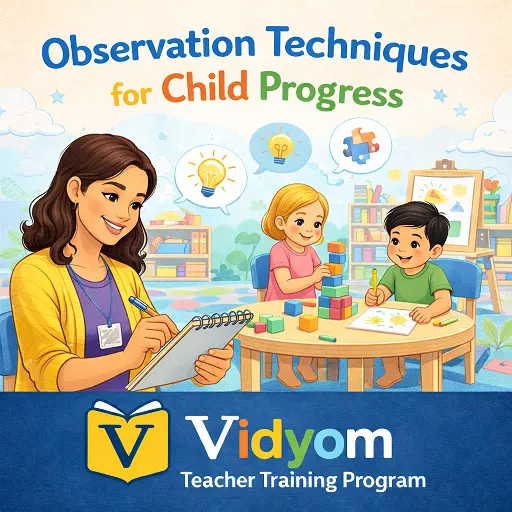
Observation Techniques Child Progress FAQs
These simple answers help preschool teachers observe children, write short notes, collect evidence, track progress, and share clear updates with parents.
What are observation techniques child progress methods?
What is an anecdotal note in preschool observation?
How can teachers use tallies for child progress?
Can teachers use photo evidence for preschool assessment?
How often should teachers observe each child?
How should teachers share child progress with parents?
📲 Download Vidyom – Kids Learning App
Enjoy safe and distraction-free learning for kids. Install the Vidyom app now for an ad-free experience, fun lessons, and interactive activities.