
Creating Worksheets and Printables – Simple Preschool Teacher Guide
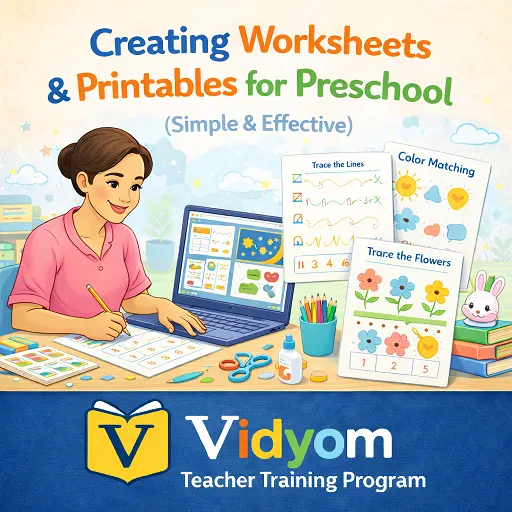
Creating worksheets and printables for preschool means making clean, visual, and easy-to-print pages that fit tiny hands, short attention spans, and simple classroom routines.
This lesson helps teachers design simple worksheets with big spaces, clear pictures, strong lines, and one clear skill per page. The goal is to make printable activities that are child-friendly, fast to prepare, and useful during centers, small groups, or home practice.
Creating Worksheets and Printables – Overview and Materials
A good preschool worksheet should focus on one small skill at a time. This keeps the page easy for children and simple for the teacher to explain.
- Goal: Use one skill per page, such as color matching, tracing, counting, sorting, or circling.
- Materials: Use bold icons, thick lines, dot markers, crayons, scissors, glue, and page protectors.
- Size: Use A4 or Letter size, safe margins, large fonts, and clear spacing.
- Time saver: Reuse the same frame and change only pictures, words, numbers, or tasks each week.
Design Basics for Readable Preschool Worksheets
Preschool children need large, clear, and calm worksheet designs. Avoid crowded pages because too many objects can confuse young learners.
- Fonts: Use rounded sans fonts and avoid all caps for long text.
- Contrast: Use dark text on a light background. Use color only as a helpful cue.
- Spacing: Keep tracing paths wide and use only a few items in one task.
- Icons: Use clear pictures, simple outlines, start dots, and arrows where needed.
Worksheet Templates and Activity Ideas
Simple templates save time and help children understand the task quickly. Teachers can use the same layout with different letters, numbers, objects, or pictures.
- Trace and say: Add a large letter or number with a start dot and arrow.
- Match and color: Let children draw a line or color to match a picture, word, color, or object.
- Cut and sort: Use two boxes for same/different, big/small, or beginning sound practice.
- Count and circle: Show a few objects, ask children to count, and circle the correct answer.
Printing and Prep Tips for Teachers
Good printables should be easy to print, easy to carry, and easy to reuse. A simple black-and-white design often works better than a heavy full-color page.
- Ink smart: Use black-and-white lines and add color only for small headers or helpful icons.
- Reusable sheets: Put pages in protectors and use dry-erase pens to save copies.
- Bind pages: Staple on the left or top, number pages, and add small picture steps if needed.
- Accessibility: Use heavy outlines for scissors practice and provide left-handed tracing options when possible.
Classroom Use for Short and Guided Practice
Worksheets are most helpful when the teacher models the task first. Children should not be left confused with a page they do not understand.
- Model first: Show one example slowly, then let children try.
- Time box: Use 5 to 7 minutes per sheet and stop early if children lose focus.
- Differentiate: Use the same frame but make easier or harder versions with different pictures.
- Finish well: Use a stamp, sticker, or short praise, then file the finished page to send home.
40-Minute Printable Activity Timetable
This sample timetable keeps worksheet time short and mixes teacher modelling, child practice, reuse, and quick review.
- 6 minutes: Model the page and explain the task with a think-aloud.
- 8 minutes: Use Sheet 1 for trace and say practice.
- 8 minutes: Use Sheet 2 for match and color practice.
- 10 minutes: Reuse pages in protectors with dry-erase pens.
- 8 minutes: Quick check, stamp, tidy, and send pages to the folder.
Quick Quiz
Choose one option for each question and click Submit.
Teacher Reflection & Practice
After learning about creating worksheets and printables, think about how simple layouts, large spaces, clear pictures, strong lines, and one focused skill per page can make preschool activities easier for children to understand and easier for teachers to use.
Which part of worksheet preparation is most difficult for you: choosing one clear learning goal, keeping the page uncluttered, creating large child-friendly spaces, selecting simple pictures, preparing easier and harder versions, or making pages economical to print and reuse?
Review one worksheet you currently use. Notice whether children can understand the task quickly, whether the pictures and lines are large and clear, whether there are only a few items to complete, and whether the teacher can model one example before children begin independent practice.
Create one simple preschool printable for a single skill such as tracing, matching, counting, sorting, or circling. Use a clear layout, large spaces, strong outlines, and only a few task items. Model the activity first, keep practice to about 5 to 7 minutes, and prepare a reusable version with a page protector if suitable.
Designing Clear and Child-Friendly Practice Pages
Creating Worksheets and Printables FAQs for Teachers
These simple answers help preschool teachers design clean printable pages with clear layouts, big spaces, strong visuals, and short guided practice.
What does creating worksheets and printables for preschool mean?
How many skills should one preschool worksheet teach?
What font style is best for preschool printables?
How can teachers make worksheets easier for children?
How can teachers save printing cost?
Should worksheets replace hands-on activities?
📲 Download Vidyom – Kids Learning App
Enjoy safe and distraction-free learning for kids. Install the Vidyom app now for an ad-free experience, fun lessons, and interactive activities.