
Encouragement Words and Praise for Preschool Teachers
Positive reinforcement in preschool works best when teachers notice the exact behavior, praise it quickly, and use small rewards fairly. This lesson gives simple praise scripts, reward ideas, calm redirection, and classroom motivation methods.
This lesson helps teachers use encouragement words, specific praise, token jars, punch cards, group rewards, and calm do-over practice. When praise is clear and immediate, children understand which behavior to repeat.
Positive Reinforcement in Preschool with Clear Praise
Positive reinforcement means noticing and strengthening good behavior. Instead of saying only “good job,” the teacher names the action so children understand what to repeat.
- Materials: Sticker dots, star stamps, class token jar, punch cards, rule cards, and simple behavior visuals.
- Teaching flow: Notice the action, name the behavior, praise warmly, and encourage repeat practice.
- Timing: Praise quickly, especially when the child first starts the correct behavior.
- Fairness: Keep rewards small, predictable, and connected to classroom routines.
- Daily reset: Give children fresh chances every day so motivation stays positive.
Encouragement Scripts Teachers Can Use
Good encouragement words tell the child exactly what was done well. Use short sentences that are easy for preschool children to understand.
- Specific praise: “Books are on the shelf and hands are by your side. Great tidy-up, Rohan.”
- Effort praise: “You tried again even when it was hard. That is strong learning.”
- Pre-correct: “When we get crayons, we take one and pass the box. Ready?”
- Choice support: “You can sit criss-cross or sit on the spot mat. You choose.”
- Group praise: “Table 2 stacked the books carefully. That is teamwork.”
Simple Reward Systems for Preschool Classrooms
Rewards should support behavior, not replace learning. Keep them small, easy to manage, and connected with positive classroom habits.
- Token jar: The class earns 10 tokens and gets a 3-minute dance break or song choice.
- Punch cards: Five punches can allow the child to choose a storybook or classroom helper job.
- Mystery motivator: Use an envelope with a small privilege like line leader or rhyme chooser.
- Team stars: Give stars for tidy tables, kind sharing, quiet line-up, or helpful words.
- Fair use: Avoid taking away earned rewards for every mistake. Pause, reset, and teach again.
Calm Redirection with Positive Language
Redirection works best when it is brief, private when possible, and focused on the next correct action.
- Tap and point: Point to the rule card and quietly say the expected action.
- Do-over: “Let’s try walking feet again from the door.”
- First-then: “First tidy blocks, then water break.”
- Private cue: Use a small picture card instead of calling the child out loudly.
- Return to praise: Praise quickly when the child starts the expected behavior.
Simple Positive Reinforcement Practice Plan for 40 Minutes
This sample flow helps teachers practice praise, rewards, and redirection during real classroom routines.
- 6 minutes: Teach today’s rule and model the correct action.
- 8 minutes: Use specific praise during a table activity.
- 8 minutes: Practice token jar or punch card moments.
- 8 minutes: Role-play calm redirection and do-over practice.
- 5 minutes: Group reflection: “What behavior helped our class today?”
- 5 minutes: Closing praise, reset reminder, and home note if needed.
Quick Quiz
Choose one option for each question and click Submit.
Teacher Reflection & Practice
After learning about positive reinforcement in preschool, think about how specific praise, encouragement words, small rewards, calm redirection, and fresh daily chances can help children understand which positive behaviors to repeat.
Which positive behavior would you like to strengthen most in your classroom right now: tidy-up, sharing, listening, waiting, gentle hands, quiet line-up, effort, teamwork, or following directions?
During your next class, notice how often you use specific praise instead of general praise, whether children understand exactly what behavior earned the praise, and how quickly they repeat the expected action.
Choose one classroom routine and practice a simple reinforcement cycle: notice the positive action, name it clearly, praise it immediately, use a small reward only when helpful, and redirect calmly with a short do-over if the child needs another chance.
Encouraging Positive Behaviour with Meaningful Praise
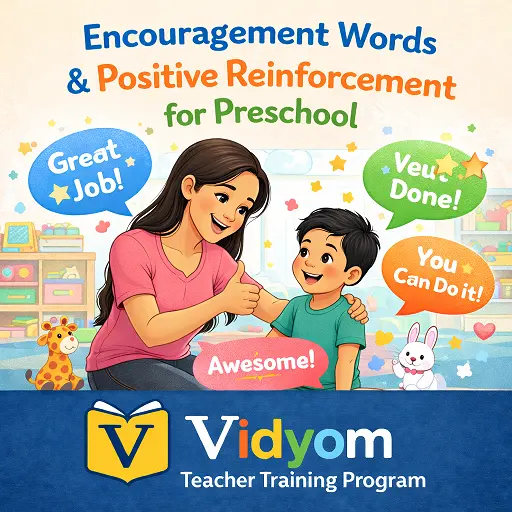
Positive Reinforcement in Preschool FAQs for Teachers
These simple answers help teachers use encouragement words, specific praise, reward systems, token jars, calm redirection, and positive classroom motivation.
What is positive reinforcement in preschool?
Why is specific praise better than general praise?
What are good encouragement words for preschool children?
How can teachers use rewards fairly?
Should teachers take away earned rewards for mistakes?
How can positive reinforcement help classroom behavior?
📲 Download Vidyom – Kids Learning App
Enjoy safe and distraction-free learning for kids. Install the Vidyom app now for an ad-free experience, fun lessons, and interactive activities.