
Positive Preschool Discipline Without Fear
Maintain discipline without fear by using calm responses, clear choices, natural consequences, routines, and respectful repair. This lesson helps teachers guide behavior without shouting, threats, fear, or harsh punishment.
This lesson helps preschool teachers manage classroom behavior with confidence and kindness. Children learn discipline better when adults stay calm, explain what to do, offer simple choices, and help them rejoin the activity after a short reset.
Maintain Discipline Without Fear Using Positive Guidance
Discipline means teaching children what to do next. Fear may stop behavior for a moment, but positive guidance builds safety, trust, self-control, and better classroom habits.
- Be predictable: Use the same signal and the same calm response.
- Teach before crisis: Model rules, practice transitions, and praise the expected action.
- Respect first: Use a low voice, close distance, simple words, and kind body language.
- Repair quickly: Use a short reflection, then help the child rejoin the activity.
- Focus on skill: Ask what skill the child needs: waiting, sharing, using words, or calming the body.
Calm Responses for Preschool Misbehavior
The teacher’s calm voice helps children borrow calm. Give short directions that tell the child exactly what to do.
- Neutral voice: Say, “We walk inside,” instead of shouting “Don’t run!”
- State the action: Use phrases like “hands to self,” “feet on floor,” and “eyes here.”
- Use proximity: Stand nearby and guide gently when appropriate.
- Notice success: Say, “I see you sitting ready,” when the child starts to correct the action.
- Keep it short: Long lectures are hard for preschool children to follow.
Choices and Natural Consequences
Simple choices reduce power struggles. Natural consequences should be connected to the behavior and should teach, not shame.
- Two good choices: “You can choose blocks or books for five minutes.”
- If/then frame: “If we run, someone can get hurt. We walk inside.”
- Natural link: If crayons are thrown, crayons rest for three minutes.
- Reset chance: “Show ready hands, then you can rejoin.”
- No threat needed: Keep the tone firm, calm, and respectful.
De-escalation Steps for Young Children
When a child is upset, fewer words are better. The first goal is safety and calm, not a long explanation.
- Lower your voice: Speak slowly and reduce language.
- Offer space: Give a safe place or one calm choice.
- Remove the audience: Keep other children learning and reduce attention on the behavior.
- Guide regulation: Use breathing, water, quiet corner, or a short reset task.
- Reflect briefly: Ask, “What happened?” and “What can we do next time?”
Family Link for Home and School Consistency
Home and school should use similar simple words. This helps children hear the same message in different places.
- Daily note: Share one success and one practice goal.
- Shared words: Use phrases like “ready body,” “gentle hands,” and “walking feet.”
- Home script: Parents can use the same two-choice method at home.
- Positive start: Tell families what the child did well before discussing the behavior need.
- Short plan: Keep home-school behavior goals simple and realistic.
Simple Discipline Practice Plan for 40 Minutes
This sample plan helps teachers practice calm discipline routines before problems become bigger.
- 5 minutes: Rule reminder and teacher model.
- 8 minutes: Practice calm words like “walking feet” and “gentle hands.”
- 8 minutes: Role-play two good choices and natural consequences.
- 8 minutes: De-escalation practice with a simple classroom scenario.
- 6 minutes: Reflection cards: “What happened?” and “What next?”
- 5 minutes: Praise, family note, and calm closing routine.
Quick Quiz
Choose one option for each question and click Submit.
Teacher Reflection & Practice
After learning how to maintain discipline without fear, think about how calm language, clear choices, natural consequences, short de-escalation steps, respectful repair, and consistent home-school messages can help children develop better self-control.
Which behavior situation is most difficult in your classroom right now: running, hitting, refusing, shouting, grabbing materials, waiting for a turn, or calming down after becoming upset?
During your next challenging moment, notice whether your voice stays calm, the direction clearly tells the child what to do, the choice is simple, and the child is able to take a small step toward rejoining the activity.
Choose one common behavior and prepare a calm response in advance: state the expected action, offer two acceptable choices when helpful, use a related consequence if needed, allow a short reset, and help the child rejoin with specific praise.
Guiding Children with Calm and Respect
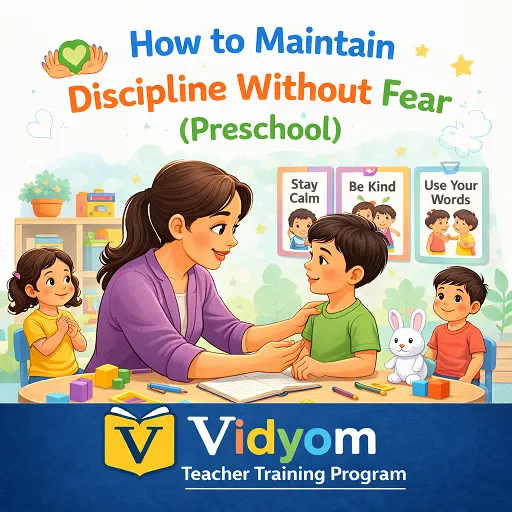
Maintain Discipline Without Fear FAQs for Preschool Teachers
These simple answers help teachers use positive discipline, calm correction, choices, natural consequences, de-escalation, and respectful classroom management.
What does maintain discipline without fear mean?
Why should preschool teachers avoid fear-based discipline?
What should a teacher do first during misbehavior?
How do choices help with preschool discipline?
What is a natural consequence in preschool?
How can teachers calm an upset child without fear?
📲 Download Vidyom – Kids Learning App
Enjoy safe and distraction-free learning for kids. Install the Vidyom app now for an ad-free experience, fun lessons, and interactive activities.