
How Children Learn Through Play in Preschool
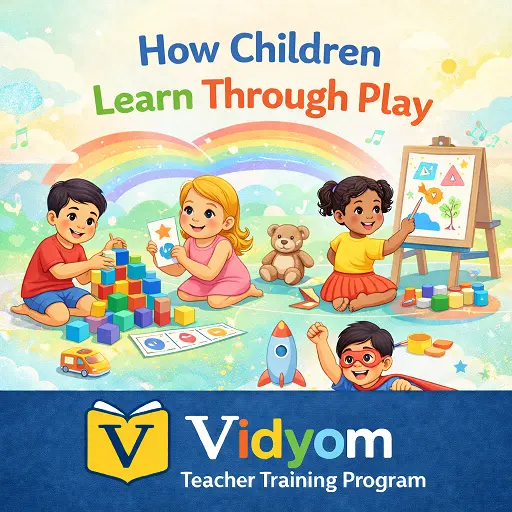
How children learn through play is an important idea for every preschool teacher. Play-based learning helps young children build language, thinking, social skills, confidence, memory, movement, and classroom habits through joyful hands-on activities.
This lesson explains play-based learning, preschool play activities, teacher guidance, low-cost classroom materials, and simple assessment through observation. When teachers plan play with a clear purpose, children learn naturally while moving, talking, building, pretending, sharing, and exploring.
How Children Learn Through Play – Why It Works
Play is not just free time. In early childhood learning, play helps children use their body, senses, language, imagination, and thinking together. A good play activity gives children a chance to try, repeat, solve problems, talk with others, and feel proud of small success.
- Active brains: Touching, moving, building, and sorting help children understand ideas better than only listening.
- Language grows: Play gives children many chances to ask questions, use new words, and explain their thinking.
- Social skills improve: Children practise sharing, waiting, helping, leading, following, and solving small problems.
- Confidence builds: Small play successes help children feel, “I can try again.”
- Memory becomes stronger: Repeated songs, games, picture cards, and routines help children remember learning.
Types of Play for Preschool Children
Different types of preschool play activities support different skills. Teachers can mix free play, guided play, role-play, construction, movement, and games to support the whole child.
- Exploratory play: Sand, water, beads, clay, leaves, cups, and blocks help children test ideas.
- Constructive play: Towers, puzzles, craft, drawing, and pattern work build planning and fine motor skills.
- Pretend play: Home corner, shop, doctor set, and school play build language and social understanding.
- Physical play: Action rhymes, obstacle paths, jumping, balancing, and bean-bag games build control and confidence.
- Guided games: Sorting, matching, “listen and do,” number games, and simple rules help children learn with purpose.
Teacher’s Role in Play-Based Learning
In play-based learning, the teacher does not only watch. The teacher prepares the space, gives a simple goal, models quickly, observes carefully, asks helpful questions, and extends the activity when children are ready.
- Set a clear purpose: Say, “Today we will sort by color,” or “Today we will count the blocks.”
- Model one example: Show the first step, then let children try by themselves.
- Ask open questions: Use questions like “What happens if we add one more?” or “How can we make it taller?”
- Extend the idea: Add one small challenge when children understand the first task.
- Use specific praise: Say, “You counted eight beads carefully,” instead of only saying “good.”
Setup and Low-Cost Materials
A preschool classroom does not need expensive toys for meaningful play. Safe, clean, simple, and organized materials can create strong hands-on learning.
- Learning corners: Keep small areas for blocks, art, reading, pretend play, and sorting.
- Low-cost materials: Use bottle caps, cups, sticks, old magazines, paper, clay, leaves, and safe household items.
- Picture labels: Put pictures on baskets so children can clean up independently.
- Simple rules: Use three picture rules: share, tidy, and gentle hands.
- Short time blocks: Use 10 to 15 minute centers and a simple signal for changing activities.
Assess Learning Through Play
Teachers can assess learning without making preschool children feel afraid. Observation during play shows what a child can say, count, match, share, build, explain, and try.
- Observation notes: Write short notes about sorting, counting, speaking, sharing, and problem-solving.
- Photo samples: Take pictures of completed work to show progress to parents when allowed by school policy.
- Exit talk: Ask one simple question like “How many red blocks did you use?”
- Peer explaining: Ask one child to explain the activity to a friend.
- Small checklist: Track one skill at a time instead of testing many things together.
Common Mistakes to Avoid
- Only free play without purpose: Add a small goal, quick model, or simple question.
- Too many toys at once: Rotate materials and keep limited choices to avoid confusion.
- No clean-up routine: Use picture labels, a short song, and a clear place for each item.
- Doing the activity for the child: Let the child try, make small mistakes, and solve simple problems.
- Only whole-class play: Use small groups and turns so every child gets a chance.
Mini Activities You Can Use Today
- Pattern Train: Give bottle caps and sticks. Ask children to make a cap-stick-cap-stick pattern.
- Sound Jump: Place letter cards on the floor. Say a sound and let children jump on the matching letter.
- Shop Role-play: Use toy fruits or picture cards. Children “buy” items and count them.
- Story Build: Give three picture cards and ask children to arrange beginning, middle, and end.
- Sorting Basket: Ask children to sort objects by color, size, shape, or use.
Quick Quiz
Choose one option for each question and click Submit.
Teacher Reflection & Practice
After learning how children learn through play, think about how purposeful play, teacher guidance, and simple materials can support learning in your classroom.
Which classroom skill, such as counting, language, sharing, problem-solving, or fine motor development, could you teach more effectively through play?
During the next play activity, notice how children explore materials, communicate, solve small problems, take turns, and respond to your questions or guidance.
Plan one short play-based activity with a clear learning goal, simple materials, and one helpful question that encourages children to think, explain, or try something new.
Learning and Growing Through Play
Play gives young children natural opportunities to explore, communicate, imagine, and solve simple problems. Through games, movement, stories, and hands-on activities, preschoolers develop important thinking, language, social, emotional, and physical skills.
How Children Learn Through Play- FAQ
These simple answers help new teachers understand play-based learning, preschool play activities, teacher guidance, and classroom learning through play.
How children learn through play in preschool?
Why is play important for preschool learning?
What is play-based learning?
What are good preschool play activities?
What is the teacher’s role during play?
Can teachers assess learning through play?
📲 Download Vidyom – Kids Learning App
Enjoy safe and distraction-free learning for kids. Install the Vidyom app now for an ad-free experience, fun lessons, and interactive activities.