
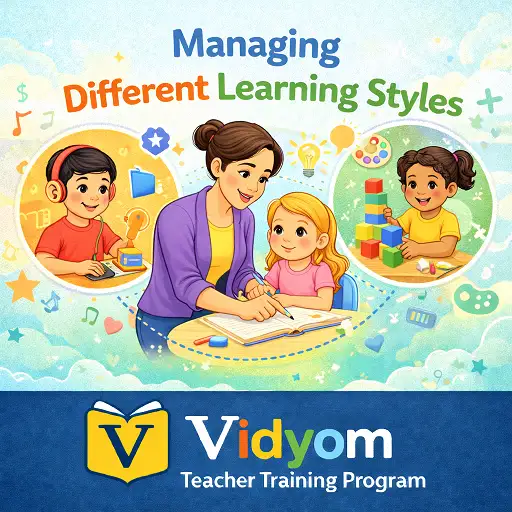
Managing Different Learning Styles – Why It Matters
Managing different learning styles helps preschool teachers teach the same concept in more than one way. This lesson explains how to support visual learners, auditory learners, kinesthetic learners, and mixed ability classrooms using simple child-centered teaching methods.
Children do not all learn in the same way. Some understand better through pictures, some through songs and spoken instructions, and some through movement, touch, and hands-on practice. A good teacher uses flexible activities so every child gets a fair chance to understand.
Managing Different Learning Styles – Why It Matters
Preschool learning styles are not fixed labels. They are clues that help teachers present one lesson in different ways. When children see, hear, speak, move, touch, and practise, more children can understand the same concept.
- More engagement: Picture, sound, and movement keep young children interested for longer.
- Better understanding: A child may understand after seeing a picture, hearing a chant, or doing the action.
- More confidence: Children feel capable when the lesson matches their learning comfort.
- Support for mixed ability: Different methods help children with different language, attention, and skill levels.
- Fair classroom practice: Every child gets more than one way to join the lesson.
Observe and Note Learning Preferences
Start with simple observation. Do not label a child forever as only visual, auditory, or kinesthetic. Instead, notice what helps the child understand today’s lesson better.
- See: Notice who watches pictures, points to cards, traces shapes, or follows visual steps.
- Hear: Notice who repeats sounds, sings steps, follows voice cues, or remembers rhymes.
- Do: Notice who learns through building, sorting, jumping, acting, touching, or moving.
- Note: Use a simple sheet with three columns: Visual, Auditory, Kinesthetic.
- Plan: Choose one small strategy from each style for tomorrow’s lesson.
Visual Strategies for Preschool Learners
Visual learners often understand better when they can see pictures, colors, shapes, arrows, examples, and step-by-step cards.
- Picture cards: Show the lesson steps as simple pictures.
- Color coding: Use red, blue, green, or yellow to group objects or steps.
- Tracing arrows: Show stroke order with large arrows for letters and numbers.
- Before and after examples: Show what to do and what not to do in a gentle way.
- Routine board: Display the daily order with clear icons.
Auditory Strategies for Preschool Learners
Auditory learners often respond well to sound, rhythm, spoken steps, rhymes, stories, and repeated phrases.
- Chants and claps: Use “say, clap, say” for letters, sounds, or counting.
- Call and response: Teacher says “circle time,” children say “ready.”
- Short story cues: Use a small story to explain a rule or routine.
- Sound timers: Use a soft bell, clap pattern, or transition song.
- Repeat and echo: Say the instruction and let children repeat it once.
Kinesthetic Strategies for Preschool Learners
Kinesthetic learners understand better when they use movement, touch, objects, actions, and role-play.
- Floor letters or numbers: Ask children to jump, step, or point to the correct card.
- Hands-on sorting: Let children move objects into baskets by color, size, or shape.
- Action words: Act out verbs like jump, clap, run, sit, and smile.
- Role-play: Practise line-up, sharing, greeting, or handwashing through pretend play.
- Build and count: Use blocks, beads, sticks, or caps for number practice.
Mix Styles and Differentiate
Differentiated teaching means changing the method, support, or difficulty so more children can learn. In preschool, the best method is often simple: show it, say it, and do it.
- Mini-cycle: Use one picture demo, one chant, and one hands-on task.
- Group by need: Use a visual table, listening circle, and movement mat.
- Change difficulty: Give easier cards to beginners and challenge cards to advanced learners.
- Check understanding: Ask children to point, say, build, sort, or act the answer.
- Praise the method: Say, “You watched the arrows and traced slowly.”
Quick Quiz
Choose one option for each question and click Submit.
Teacher Reflection & Practice
After learning about managing different learning styles, think about how using pictures, sounds, movement, and hands-on practice can help more children understand the same lesson.
Which teaching method do you use most often, and which visual, auditory, or hands-on strategy could you add to make the lesson more flexible?
During your next class, notice which children respond better to pictures, spoken instructions, songs, movement, objects, or a combination of different methods.
Teach one simple concept using the “show, say, and do” method: show a visual example, explain it aloud, and then let children practise it through movement or hands-on activity.
Supporting Every Child’s Way of Learning
Every preschool child understands and responds to lessons differently. By combining pictures, sounds, movement, speaking, and hands-on activities, teachers can create flexible learning experiences that help every child participate, understand, and grow with confidence.
Managing Different Learning Styles – FAQ
These simple answers help preschool teachers support visual learners, auditory learners, kinesthetic learners, and mixed ability classrooms.
What does managing different learning styles mean?
Why is managing different learning styles important in preschool?
What are visual learning strategies for preschool children?
What are auditory learning strategies for preschool children?
What are kinesthetic learning strategies for preschool children?
Should teachers label children by one learning style?
📲 Download Vidyom – Kids Learning App
Enjoy safe and distraction-free learning for kids. Install the Vidyom app now for an ad-free experience, fun lessons, and interactive activities.