
Motivating Preschool Children in the Classroom
Motivating preschool children means helping young learners feel safe, curious, confident, and ready to try. This lesson explains preschool motivation, positive reinforcement, classroom encouragement, tiny goals, playful challenges, and simple routines that make children enjoy learning.
Young children are not motivated by pressure for long. They respond better to safety, joy, choice, praise, movement, stories, and small success. When a teacher gives reachable tasks and celebrates effort, children build child confidence and slowly learn to try again.
Motivating Preschool Children – Why Motivation Matters
Early childhood motivation grows when children feel that learning is possible and enjoyable. A motivated child does not need to be perfect. The goal is to help the child try, repeat, ask questions, and feel proud of effort.
- Effort grows: Children try longer when the task feels reachable.
- Joy supports memory: Songs, stories, games, and small wins help children remember learning.
- Behavior improves: Engaged children usually show fewer conflicts and less wandering.
- Confidence builds: A child who hears “You tried again” learns that effort matters.
- Belonging increases: Fair chances to succeed help every child feel important in class.
Warm Climate and Belonging
Children become more motivated when the classroom feels safe and welcoming. A warm climate helps children take part without fear.
- Door greeting: Say the child’s name and offer a wave, smile, namaste, or high-five choice.
- Helper jobs: Rotate simple roles so every child feels useful.
- Visual schedule: Pictures reduce worry and help children know what will happen next.
- Calm corner: A small reset place helps children come back to learning safely.
- Class celebration: Celebrate group effort with a song, story choice, or dance minute.
Tiny Goals and Simple Choices
Big tasks can feel scary for preschool children. Tiny goals and two simple choices make learning feel easier and more inviting.
- Use one-step goals: “Put three blocks in the tray” is better than a long instruction.
- Give choice power: Let children choose crayon or marker, desk or floor, red card or blue card.
- Use short timers: Try 30 to 60 seconds of focus, then a short movement break.
- Show progress: Use a sticker path, star chart, or bead string to show effort.
- Celebrate action: Say, “You tried again,” “You matched carefully,” or “You waited for your turn.”
Specific Praise and Positive Reinforcement
Positive reinforcement works best when the teacher praises the exact action, not only the child. This teaches children which behavior to repeat.
- Be specific: Say, “You sorted all red blocks carefully.”
- Praise effort: Say, “You tried again even when it was hard.”
- Use group rewards: Marbles in a jar can lead to a song, dance, or story choice.
- Use simple personal rewards: Three stars can mean choosing a helper role.
- Avoid over-rewarding: Use praise, interest, and encouragement more than material rewards.
Playful Challenge and Variety
Playful learning keeps preschool children interested. A small challenge makes the activity exciting without creating pressure.
- Game versions: Use treasure hunt letters, relay counting, mystery bag shapes, or matching races.
- Partner play: Let children build with a buddy and then tell one sentence about it.
- Movement add-ons: Let children hop to answers, clap a pattern, or act out a word.
- Level-up cards: Keep easy and harder cards so each child gets a suitable challenge.
- Story hook: Start with a puppet, picture, or real object to create curiosity.
When Motivation Drops
Motivation can drop because of tiredness, hunger, noise, repeated failure, fear, or a task that feels too hard. First understand the reason, then adjust the activity.
- Check basics: Notice sleep, hunger, seating, noise, and classroom crowding.
- Shrink the task: Give one smaller step instead of the full activity.
- Change material: Use blocks, cards, crayons, clay, or movement instead of only worksheets.
- Switch partner: A kind buddy can help a child rejoin the activity.
- Repair and retry: Breathe together, set a tiny goal, and praise the next effort.
Quick Quiz
Choose one option for each question and click Submit.
Teacher Reflection & Practice
After learning about motivating preschool children, think about how small goals, specific praise, playful activities, and a warm classroom environment can encourage children to participate and keep trying.
Which children in your classroom may need smaller goals, more encouragement, extra choices, or a different activity style to feel successful and motivated?
During your next lesson, notice when children become more interested, confident, or willing to try again. Look for changes after praise, movement, games, choices, or small successes.
Choose one activity and break it into a small reachable goal. Give children a simple choice, praise their exact effort, and add one playful element such as a song, story, movement, or game.
Inspiring Young Learners to Participate
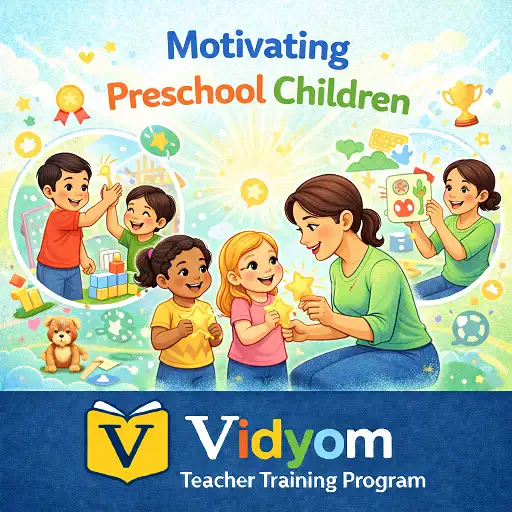
Preschool children feel motivated when learning is joyful, achievable, and encouraging. Warm praise, playful activities, simple choices, small goals, and recognition of effort can build confidence, curiosity, and a positive desire to learn.
Motivating Preschool Children FAQs for Teachers
These simple answers help preschool teachers use encouragement, small goals, playful activities, and positive reinforcement in the classroom.
What does motivating preschool children mean?
Why is motivation important in preschool?
How can teachers motivate preschool children daily?
What kind of praise works best for preschool children?
Should teachers use rewards to motivate children?
What should teachers do when a child loses motivation?
📲 Download Vidyom – Kids Learning App
Enjoy safe and distraction-free learning for kids. Install the Vidyom app now for an ad-free experience, fun lessons, and interactive activities.