
Oral Tests Fun Quizzes Preschool Teacher Guide
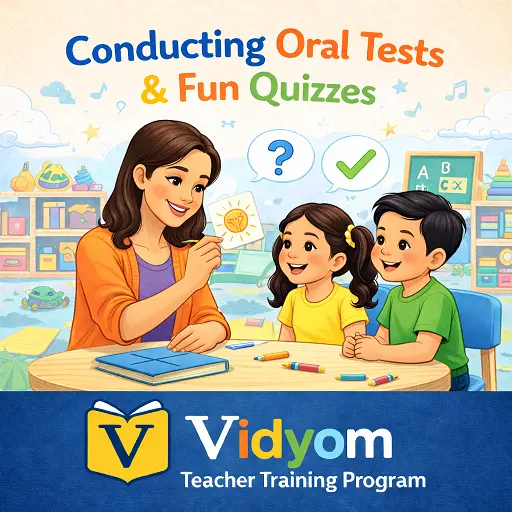
Oral tests fun quizzes preschool activities should feel like short games, not pressure. This lesson helps teachers use picture prompts, quick turns, quiz games, simple scoring, and fair classroom routines for Pre-KG, LKG, and UKG learners.
This lesson helps teachers check learning through speaking, pointing, matching, counting, and short quiz games. A calm oral assessment routine gives every child a fair chance and gives teachers quick, useful results.
Oral Tests Fun Quizzes Preschool – Overview and Setup
Oral checks should be short, playful, and focused on one or two skills. Teachers can use cards, objects, actions, and simple games to see what children understand.
- Choose 1 or 2 skills: Check one sound, one number skill, one vocabulary set, or one story sequence.
- Prepare materials: Use picture cards, letter cards, number cards, counters, puppets, name sticks, or a timer.
- Use small groups: Work with 4 to 6 children at a time so each child gets a turn.
- Keep prompts short: Use simple prompts like “Show 5,” “Find /s/,” or “What comes next?”
- Record quickly: Use I for independent, H for with help, and P for needs practice.
Question Types and Oral Test Routines
Preschool questions should allow children to answer by speaking, pointing, tapping, acting, matching, or showing objects. This makes the test fairer for shy or early-stage learners.
- Point and name: Show a picture and ask the child to name the color, shape, animal, letter, or object.
- This or that: Give two choices and let the child tap or say the answer.
- Say and do: Ask children to clap, jump, point, or act based on the answer.
- Count and show: Ask the child to show a number using counters, fingers, blocks, or dots.
- Story order: Give three picture cards and ask the child to arrange first, next, and last.
Fun Quiz Games for Preschool Classrooms
Game formats make oral checks feel light and enjoyable. The teacher can still collect useful evidence while children feel like they are playing.
- Pass the Card: Play music, stop the card, and ask the child with the card one simple question.
- Lucky Bowl: Children pick a card or object from a bowl and answer the prompt.
- Tower Time: A correct answer adds one block to a class tower.
- Picture Path: A child moves a token one step after each correct answer.
- Puppet Quiz: A puppet asks the questions so shy children feel more comfortable.
Scoring and Feedback for Oral Checks
Scoring should be quick and useful. The goal is to plan the next teaching step, not to make children feel worried.
- Use simple codes: I means independent, H means with help, and P means needs practice.
- Write one note: Add a short line such as “counts to 8 with blocks” or “needs help with /m/ sound.”
- Praise effort: Say what the child did well, such as “You listened carefully to the first sound.”
- Give one next step: Plan one small target for the next lesson or home practice.
- Do not over-score: Avoid long marksheets for every small answer.
Safety and Fairness in Preschool Quizzes
A good oral test routine gives every child a chance and keeps the mood positive. Children should never feel shame during a quiz.
- Equal turns: Use name sticks or a turn chart so the same confident children do not answer every time.
- No shaming: If a child is wrong, model the answer calmly and give another chance later.
- Support shy learners: Allow pointing, tapping, choosing, whispering, or answering with a friend first.
- Adjust difficulty: Use easier choices for children who need help and extension questions for ready learners.
- Keep the pace happy: Use short turns, smiles, praise, and movement breaks.
Sample 40-Minute Oral Test and Quiz Cycle
This sample cycle fits inside a normal preschool lesson and gives the teacher useful assessment evidence.
- 6 minutes: Review with picture cards, actions, or a short rhyme.
- 10 minutes: Play Pass the Card and record quick notes.
- 10 minutes: Play Tower Time or Lucky Bowl and add tally marks.
- 8 minutes: Do exit checks with 4 to 5 children.
- 4 minutes: Mark I, H, or P codes in the teacher checklist.
- 2 minutes: Write one next step for tomorrow’s lesson.
Quick Quiz
Choose one option for each question and click Submit.
Teacher Reflection & Practice
After learning about oral tests fun quizzes preschool routines, think about how short questions, playful quiz games, simple scoring, equal turns, and positive feedback can help you check learning without making children feel worried or pressured.
Which part of oral assessment is most difficult in your classroom: choosing short questions, giving every child a turn, supporting shy learners, keeping the pace active, recording results quickly, or giving useful feedback after an answer?
During your next oral quiz, notice whether children understand the prompts quickly, whether the same confident children answer most often, which children prefer pointing or choosing instead of speaking, and whether your questions stay short, fair, and encouraging.
Run one short quiz activity with a small group of 4 to 6 children. Use one game such as Pass the Card, Lucky Bowl, Tower Time, or Puppet Quiz, record each child with I, H, or P, and write one small next step for the following lesson.
Making Preschool Assessment Playful and Comfortable
Short oral tests and fun quiz activities help teachers understand what preschool children know without creating unnecessary pressure. Speaking, pointing, matching, counting, picture cards, puppets, movement games, and simple response choices allow every child—including shy learners—to participate confidently while giving teachers useful progress information.
Oral Tests Fun Quizzes Preschool FAQs
These simple answers help preschool teachers conduct oral tests, playful quiz games, quick checks, fair turns, and child-friendly assessment activities.
What are oral tests fun quizzes preschool activities?
Why are oral tests useful in preschool?
How can teachers make preschool quizzes fun?
How should teachers score oral quizzes?
How can shy children answer oral test questions?
How often should preschool teachers conduct oral quizzes?
📲 Download Vidyom – Kids Learning App
Enjoy safe and distraction-free learning for kids. Install the Vidyom app now for an ad-free experience, fun lessons, and interactive activities.