
Sound Facts for Kids – Amazing and Fun
Welcome to our sound facts for kids page—perfect for fun learning for kids! Listen, look, and learn how vibrations make the sounds we hear. When something shakes, it creates sound waves that travel through air, water, and even solids. You’ll explore loud and soft sounds, high and low pitch, echoes, and why it’s quiet in space. Tap play, repeat the key words, and try easy experiments at home like humming, clapping, or tapping a glass to feel the vibrations.
- Sound is made when something vibrates — like a guitar string or drum!
- It travels through air, water, and even solid things.
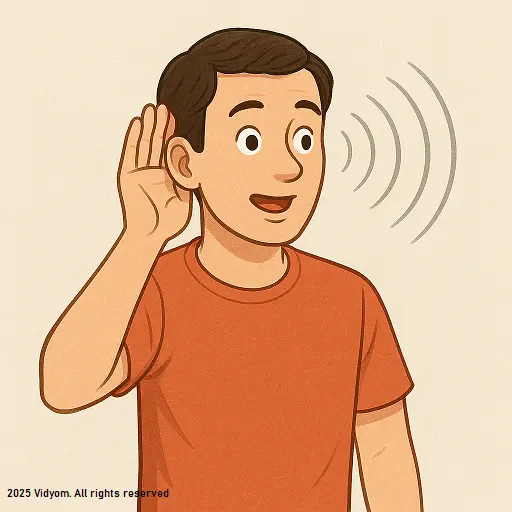
- Our ears catch sound waves and send them to the brain to understand.
- Sound moves faster in water than in air!
- Too much loud sound can hurt your ears — so listen safely!
- Pitch tells how high or low a sound is—small, tight strings make high notes; long, loose ones make low notes.
- Loudness is measured in decibels (dB)—keep volumes sensible to protect hearing.
- Sound needs a medium (air, water, or solid) to travel—there’s no sound in space!
- An echo is sound bouncing back after hitting walls, cliffs, or buildings.
- Bats and dolphins use very high sounds called ultrasound for echolocation to find their way.
Sound Facts at a Glance
This table gives clear sound facts for kids in one place. Children can quickly learn about vibrations, sound waves, pitch, loudness, echoes, hearing, ultrasound, and how sound travels through different materials.
| Detail | Sound Information | Easy Meaning for Kids |
|---|---|---|
| Vibrations | Sound is made when something vibrates, such as a guitar string or drum | Sound begins when something shakes or vibrates. |
| Sound Travel | Sound can travel through air, water, and solid materials | Sound can move through gases, liquids, and solids. |
| Hearing | Our ears catch sound waves and send information to the brain | Your ears collect sounds and your brain helps you understand them. |
| Speed in Water | Sound moves faster in water than in air | Sound can travel more quickly through water than through air. |
| Hearing Safety | Too much loud sound can hurt the ears | Very loud sounds can damage hearing, so keep volumes sensible. |
| Pitch | Pitch tells how high or low a sound is | Pitch tells us whether a sound is high or low. |
| Strings and Pitch | Small, tight strings can make higher notes, while long, loose strings can make lower notes | Changing a string can change how high or low its sound is. |
| Loudness | Loudness is measured in decibels, written as dB | Decibels tell us how loud a sound is. |
| Sound Medium | Sound needs a medium such as air, water, or a solid to travel | Sound needs something to travel through. |
| Sound in Space | There is no sound in empty space because sound has no medium to travel through | Space is silent because there is almost nothing to carry sound. |
| Echo | An echo is sound bouncing back after hitting walls, cliffs, or buildings | An echo is a sound that comes back to you. |
| Ultrasound | Bats and dolphins use very high sounds called ultrasound for echolocation | Bats and dolphins use special high sounds to help find their way. |
Sound Questions and Answers for Kids
Test what you remember from these sound facts for kids. Read each question, think about the answer, and then tap Show Answer.
What makes sound?
Answer: Sound is made when something vibrates.
What can sound travel through?
Answer: Sound can travel through air, water, and solid things.
How do our ears help us understand sound?
Answer: Our ears catch sound waves and send them to the brain to understand.
Does sound move faster in water or in air?
Answer: Sound moves faster in water than in air.
What does pitch tell us about a sound?
Answer: Pitch tells us how high or low a sound is.
What unit is used to measure loudness?
Answer: Loudness is measured in decibels, written as dB.
Why is there no sound in space?
Answer: Sound needs a medium such as air, water, or a solid to travel, so there is no sound in space.
What is an echo?
Answer: An echo is sound bouncing back after hitting walls, cliffs, or buildings.

Sound Facts for Kids – Discover How Sound Works
Learn simple and interesting sound facts for kids, including vibrations, sound waves, how we hear, echoes, how sound travels, and why very loud sounds can harm our ears.
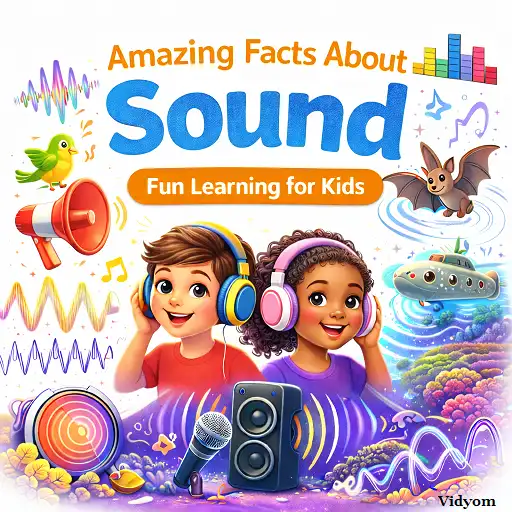
What We Learned About Sound
Sound begins when something vibrates and creates waves that can travel through air, water, and solid materials. Our ears catch these sound waves, while pitch tells us whether a sound is high or low and decibels measure loudness. Echoes, ultrasound, and safe listening habits help us understand even more about how sound works.
For Parents and Teachers
- Play the fact audio and ask the child what must happen before a sound is made.
- Let the child gently hum, clap, or tap an object and notice the vibrations that create sound.
- Compare high and low sounds, then ask the child to explain what pitch means.
- Reinforce safe listening by explaining that very loud sounds can hurt the ears.
Read-Aloud Practice
Read aloud: “Sound is made when something vibrates.”
Try this: “Sound can travel through air, water, and solid things.”
Remember: “An echo is sound bouncing back after hitting a surface.”
Learning tip: Ask the child to make one gentle sound, identify what is vibrating, describe whether the sound is high or low, and explain what an echo is. This helps reinforce vibrations, pitch, sound travel, and echoes.
Explore More Facts for Kids
Keep learning with the next fun facts lessons for kids.






Sound Facts for Kids – Quick FAQ
These quick questions help children review sound facts for kids in simple words.
What makes sound?
How do we hear sound?
Where does sound travel faster, air or water?
What is an echo?
Can loud sound hurt ears?

📲 Download Vidyom – Kids Learning App
Enjoy safe and distraction-free learning for kids. Install the Vidyom app now for an ad-free experience, fun lessons, and interactive activities.